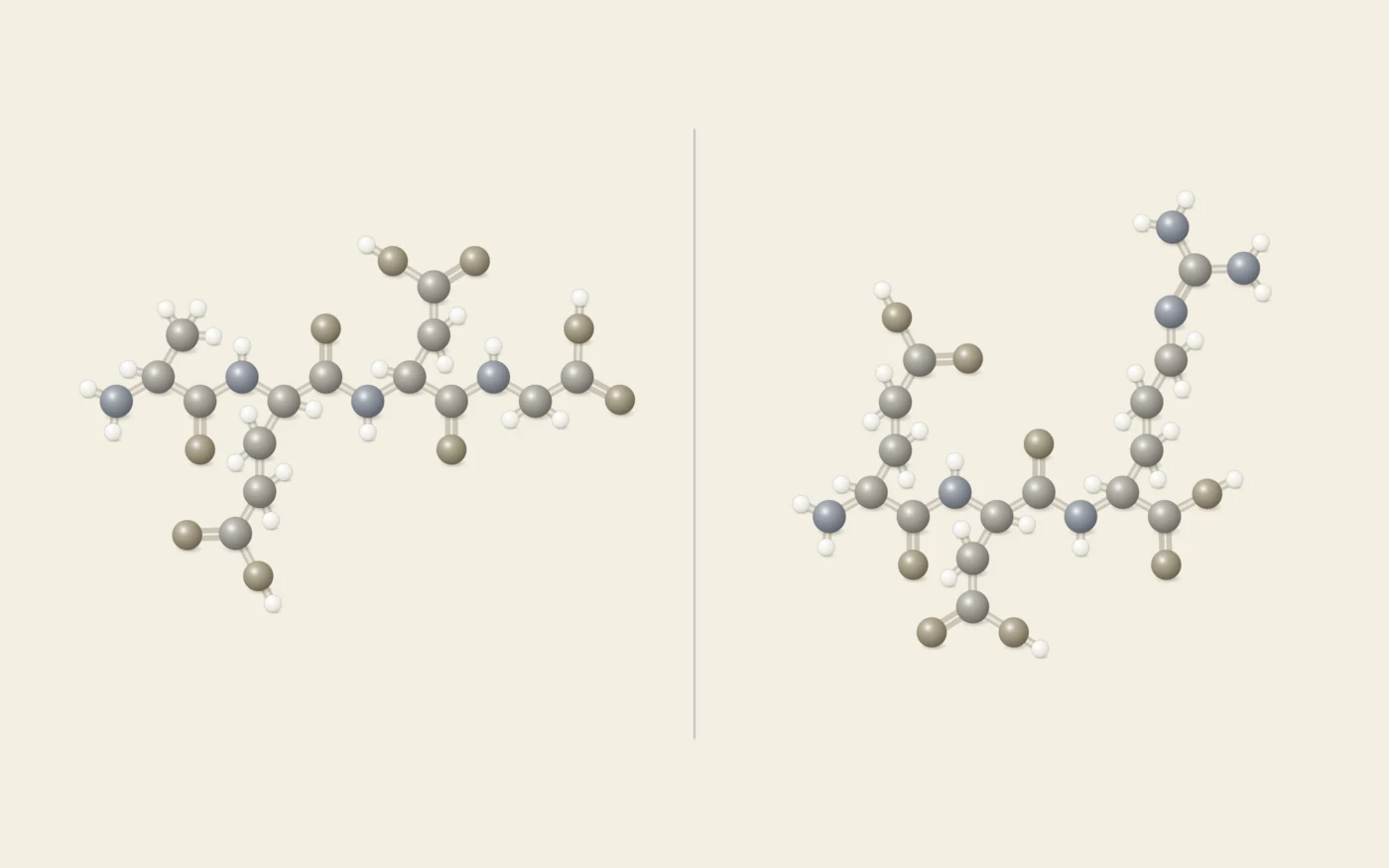
At a glance
| Epitalon | Pinealon | |
|---|---|---|
| Sequence | Ala-Glu-Asp-Gly (AEDG), tetrapeptide | Glu-Asp-Arg (EDR), tripeptide |
| Origin | Synthetic analogue of the pineal extract Epithalamin | Fully synthetic Cytogen-class peptide |
| Marketed for | Telomerase, sleep/circadian rhythm, longevity | Cognition, neuroprotection, “brain ageing” |
| Strongest data | Telomerase reactivation in cell culture; modest mouse lifespan tail | Antioxidant/neuroprotective effects in cells and rats |
| Human efficacy trial | None (the cited human cohort is on Epithalamin, the extract) | None |
| Main format | Injectable (research); oral capsules also sold | Oral capsules (~500 µg); injectable via research vendors |
| Regulatory status | Not approved (FDA/EMA/MHRA) | Not approved (FDA/EMA/MHRA) |
| Evidence grade | Thin in humans; real in-vitro mechanism | Thin; preclinical only |
| Last reviewed | 19 July 2026 | 19 July 2026 |
Epitalon and Pinealon are two of the short synthetic peptides that Vladimir Khavinson’s St. Petersburg group tied to the pineal-and-brain end of the bioregulator range, and buyers conflate them constantly. They are not interchangeable. Epitalon is the AEDG tetrapeptide sold on a telomerase-and-longevity story; Pinealon is the EDR tripeptide sold on a cognition-and-neuroprotection story.
Both trade on the same Russian research lineage, and both share the same honest limitation, which we will not bury: neither has a completed human efficacy trial.
This page compares them on the things that should actually decide the question, what each is plausibly for, how the evidence grades out, and how they differ on format and dosing. It is education, not advice, and neither peptide is an approved medicine.
Epitalon vs Pinealon: The Short Answer
If you are choosing between them, match the peptide to the goal, and lower your expectations for both. For sleep, circadian rhythm, and the telomere/longevity questions, Epitalon is the one the literature attaches to, its mechanistic signal is more famous and, in cell culture, independently replicated.
For cognitive protection under oxidative stress, Pinealon is the more relevant read, with data concentrated in neuronal and rodent models.
But the deciding fact is the one both sales pages skate over: neither compound has been shown to do anything measurable in a healthy human. Epitalon’s boldest claim, telomere lengthening and life extension in people, rests on a dish and a mouse tail, plus one unreplicated cohort study of a different substance.
Pinealon’s cognitive claim rests entirely on rats and cells. So our short answer is that this is a choice between two preclinical stories, not two proven tools, and if that framing changes your mind about buying either, that is the framing working correctly.
What Epitalon Is Best For
Epitalon’s centre of gravity is the pineal gland and its two downstream claims: telomerase and circadian rhythm. The mechanistic core is genuine.
In telomerase-negative human fetal fibroblasts, Epitalon induced hTERT expression, restored telomerase activity, and lengthened telomeres (Khavinson, Bondarev & Butyugov, 2003; PMID 12937682), and that in-vitro finding was independently echoed in 2025 across human cell lines (Al-Dulaimi et al., 2025; PMID 40908429).
That is a real, repeatable cell-culture result, and the leap from “reactivates telomerase in a dish” to “lengthens your telomeres and extends your life” is exactly that, a leap.
Where Epitalon is a more defensible pick is the quieter claim: sleep and circadian support, which follows directly from its pineal-melatonin mechanism and is the effect users most consistently describe.
If your interest is sleep, circadian rhythm, or you simply want to engage with the telomere literature at its source, Epitalon is the more relevant compound, with the caveat that the modest, believable signal (sleep) is not the loud one (age reversal). We grade each claim on the Epitalon pillar.
What Pinealon Is Best For
Pinealon’s pitch is narrower and, in one sense, more internally consistent: it is a neuroprotective, antioxidant peptide, a “help the neuron cope with oxidative stress” model rather than a stimulant one. Its best-supported idea is neuroprotection under oxidative load.
In cultured neurons it suppressed reactive-oxygen-species accumulation and reduced necrotic death (Khavinson et al., 2011; PMID 21978084); in a rat model it improved offspring spatial learning and cut ROS in cerebellar neurons (Arutjunyan et al., 2012; PMID 22567179).
Applied to neurons derived from elderly donors, it reduced an oxidative DNA-damage marker by around 23% and increased dendrite length (Kraskovskaya et al., 2024; PMID 39518916).
A 2020 review sets out the proposed antioxidant and gene-regulatory mechanism (Khavinson et al., 2020; PMID 33396470).
So if your interest is cognitive protection and neuroprotective mechanisms rather than sleep or telomeres, Pinealon is the more on-topic peptide.
The unavoidable qualifier: every one of those findings is preclinical. The maze-learning improvement was in rats, not people, and the marketing claim that Pinealon enhances cognition in a healthy adult has no human trial behind it. See the Pinealon pillar for the full grade.
How They Compare on Evidence
When we line the two up on evidence strength, they are closer than the marketing suggests: both are preclinical stories from largely one research group. They are not identical, though, and the differences run in directions you might not expect.
Epitalon has more study volume and one thing Pinealon lacks: independent in-vitro replication. Its telomerase mechanism has now been reproduced by a separate group (PMID 40908429), and it has animal lifespan data, though that data is modest and mixed.
In female SHR mice, Epitalon did not raise mean lifespan; it produced roughly a 12–13% gain in maximum lifespan and sharply reduced spontaneous leukaemia (Anisimov et al., 2003; PMID 14501183).
Its most-cited “human” result is weaker than it sounds: a 266-person elderly cohort reporting reduced mortality studied Epithalamin, the pineal extract, alongside the thymic peptide Thymalin, not synthetic Epitalon, and was unblinded, run by the originating group, and never replicated (Khavinson & Morozov, 2003; PMID 14523363).
Pinealon has a thinner file and no human data at all, no completed controlled efficacy trial exists in the peer-reviewed literature, but its preclinical work is coherent and includes a recent (2024) study in human-derived aged neurons.
Neither peptide clears the bar we think matters to a careful buyer: a completed human efficacy trial. Unlike Cortexin, which at least carries a registered-drug history and a sizeable stroke trial, both of these are pure preclinical propositions.
How They Compare on Format and Dosing
This is where a practical difference actually exists. Epitalon’s cited research is injectable, a lyophilised powder reconstituted and given subcutaneously, with a frequently quoted course of roughly 5–10 mg daily over a 10–20 day cycle, once or twice a year.
That figure is extrapolated from Russian research and vendor convention, not a dose-ranging human trial. Oral Epitalon capsules are also sold, but a digested tetrapeptide has no human data showing it reproduces the injected form.
Pinealon is primarily an oral product, the Cytogen capsule line, typically 500 µg, taken as one to two capsules daily for 10–30 days in repeated courses. That too is a vendor-and-tradition figure, not a validated human dose; the lab work used cell concentrations and weight-based rat dosing that do not translate cleanly to a capsule.
Research-chemical vendors also sell an injectable Pinealon powder with no established human injection dose.
The practical upshot: the mainstream Pinealon format (a low-dose oral capsule) carries lower procedural risk than the mainstream Epitalon format (a self-administered grey-market injection).
For a risk-aware reader who is going to try one despite the thin evidence, that difference is not trivial. We describe these protocols to inform, not to instruct anyone to self-inject an unapproved peptide.
Which Should You Choose?
Decide on goal and risk tolerance, holding both peptides to the same honest standard.
- You want sleep and circadian support, or you want to engage with the telomere literature at its source → Epitalon is the more relevant compound, and its sleep claim is its most believable one. Do not buy it expecting demonstrated age reversal in humans; that evidence does not exist.
- You want a neuroprotective, antioxidant-mechanism peptide and are drawn to cognition → Pinealon is more on-topic, and as an oral capsule it is the lower-procedural-risk format. Do not buy it expecting a proven cognitive benefit in healthy people; no human has been tested.
- You want the lower-risk format regardless of goal → Pinealon’s oral capsule beats a reconstituted Epitalon injection on sterility and dosing risk.
- You want a proven human outcome from either → neither delivers one. If a completed human efficacy trial is your bar, both fail it, and that is the most useful thing this comparison can tell you.
Whichever you lean toward, treat sourcing as its own decision: insist on a certificate of analysis for whatever you buy and, where possible, independent third-party testing, and treat a price far below market as a warning rather than a bargain.
Frequently Asked Questions
What is the difference between Epitalon and Pinealon?
Epitalon is the tetrapeptide Ala-Glu-Asp-Gly (AEDG), a synthetic analogue of the pineal extract Epithalamin, marketed for telomerase, sleep, and longevity. Pinealon is the tripeptide Glu-Asp-Arg (EDR), a fully synthetic Cytogen-class peptide marketed for cognition and neuroprotection. Different sequences, different marketed jobs, and neither has a completed human efficacy trial.
Is Epitalon or Pinealon better for cognition?
On the marketing, Pinealon is the cognition-and-neuroprotection peptide, and its preclinical data (cell and rat studies of oxidative-stress protection) is more on-topic for that goal. But there is no human trial showing Pinealon improves cognition in people, so “better for cognition” means better-aimed, not proven.
Is Epitalon or Pinealon better for longevity or anti-ageing?
Epitalon carries the longevity marketing and has the telomerase mechanism plus a modest mouse lifespan signal, but no independent human trial shows it extends life or lengthens telomeres in people. Pinealon has no longevity data in humans either. Neither is a demonstrated anti-ageing compound.
Can you take Epitalon and Pinealon together?
Vendors and forums sometimes stack them, but there is no human study of either peptide alone, let alone in combination, so there is no evidence base for a combined protocol or its safety. Anyone considering it should involve a qualified clinician rather than a forum thread.
Are Epitalon and Pinealon approved by the FDA or MHRA?
No. Neither is an approved medicine in the UK, US, or EU. Both are sold as research chemicals or supplements, their manufacture is unregulated, and using either is at your own risk.
Do either Epitalon or Pinealon have human clinical trials?
No completed human efficacy trial exists for either. Epitalon’s most-cited human data is actually on Epithalamin (the pineal extract, not the synthetic peptide) and is unreplicated; Pinealon has no controlled human efficacy trial at all. Both remain preclinical stories.
Author: Bioregulator Peptides Editorial Team
Last reviewed: 19 July 2026
References
- Khavinson VKh, Bondarev IE, Butyugov AA. Epithalon peptide induces telomerase activity and telomere elongation in human somatic cells. Bull Exp Biol Med. 2003;135(6):590–592. PMID: 12937682. DOI: 10.1023/A:1025493705728. https://pubmed.ncbi.nlm.nih.gov/12937682/ (In-vitro; telomerase-negative human fetal fibroblasts; induced hTERT, telomerase activity, telomere elongation.)
- Anisimov VN, Khavinson VKh, Popovich IG, Zabezhinski MA, et al. Effect of Epitalon on biomarkers of aging, life span and spontaneous tumor incidence in female Swiss-derived SHR mice. Biogerontology. 2003;4(4):193–202. PMID: 14501183. DOI: 10.1023/A:1025114230714. https://pubmed.ncbi.nlm.nih.gov/14501183/ (Animal; did NOT increase mean lifespan; ~12–13% gain in maximum lifespan; large reduction in spontaneous leukaemia.)
- Khavinson VKh, Morozov VG. Peptides of pineal gland and thymus prolong human life. Neuro Endocrinol Lett. 2003;24(3-4):233–240. PMID: 14523363. https://pubmed.ncbi.nlm.nih.gov/14523363/ (Observational elderly cohort, n=266; pineal extract Epithalamin + thymic Thymalin; reduced mortality. Not blinded/placebo-controlled to modern standard; by the originating group; unreplicated. Concerns Epithalamin, not synthetic Epitalon.)
- Al-Dulaimi S, Thomas R, Matta S, Roberts T. Epitalon increases telomere length in human cell lines through telomerase upregulation or ALT activity. Biogerontology. 2025;26(5):178. PMID: 40908429. DOI: 10.1007/s10522-025-10315-x. https://pubmed.ncbi.nlm.nih.gov/40908429/ (Independent in-vitro replication; telomere lengthening via hTERT/telomerase in normal cells and ALT in cancer cells.)
- Khavinson V, Ribakova Y, Kulebiakin K, Vladychenskaya E, Kozina L, Arutjunyan A, Boldyrev A. Pinealon increases cell viability by suppression of free radical levels and activating proliferative processes. Rejuvenation Research. 2011;14(5):535–541. PMID: 21978084. DOI: 10.1089/rej.2011.1172. https://pubmed.ncbi.nlm.nih.gov/21978084/ (In-vitro; dose-dependent ROS suppression and reduced necrotic death in neuronal and other cell lines.)
- Arutjunyan A, Kozina L, Stvolinskiy S, Bulygina Y, Mashkina A, Khavinson V. Pinealon protects the rat offspring from prenatal hyperhomocysteinemia. International Journal of Clinical and Experimental Medicine. 2012;5(2):179–185. PMID: 22567179. PMCID: PMC3342713. https://pubmed.ncbi.nlm.nih.gov/22567179/ (In-vivo rat model; improved offspring spatial learning, reduced ROS and necrotic cells in cerebellar neurons.)
- Kraskovskaya N, Linkova N, Sakhenberg E, et al. Short Peptides Protect Fibroblast-Derived Induced Neurons from Age-Related Changes. International Journal of Molecular Sciences. 2024;25(21):11363. PMID: 39518916. PMCID: PMC11546785. DOI: 10.3390/ijms252111363. https://pubmed.ncbi.nlm.nih.gov/39518916/ (In-vitro; EDR reduced 8-OHdG oxidative DNA-damage marker ~23% and increased dendrite length vs controls.)
- Khavinson V, Linkova N, Kozhevnikova E, Trofimova S. EDR Peptide: Possible Mechanism of Gene Expression and Protein Synthesis Regulation Involved in the Pathogenesis of Alzheimer’s Disease. Molecules. 2020;26(1):159. PMID: 33396470. PMCID: PMC7795577. DOI: 10.3390/molecules26010159. https://pubmed.ncbi.nlm.nih.gov/33396470/ (Review of proposed antioxidant, anti-apoptotic and gene-regulatory mechanisms of the EDR/Pinealon peptide.)
Dosing figures reflect protocols reported in the research literature and vendor/Cytogen-tradition convention; they are not dose-ranging human-trial recommendations. No completed controlled human efficacy trial was identified for either peptide at the time of writing. Verify any claim against the current primary source before relying on it.
Medical disclaimer. This article is for education and research information only. It is not medical advice, and nothing here is a recommendation to obtain, dose, or self-administer Epitalon, Pinealon, or any peptide. Neither is an approved medicine in the UK, US, or EU, and both are unregulated where they are sold. Consult a qualified medical professional before making any health decision. Statements about benefits reflect the current research literature, including its substantial limitations, and have not been evaluated by the FDA, MHRA, or EMA.