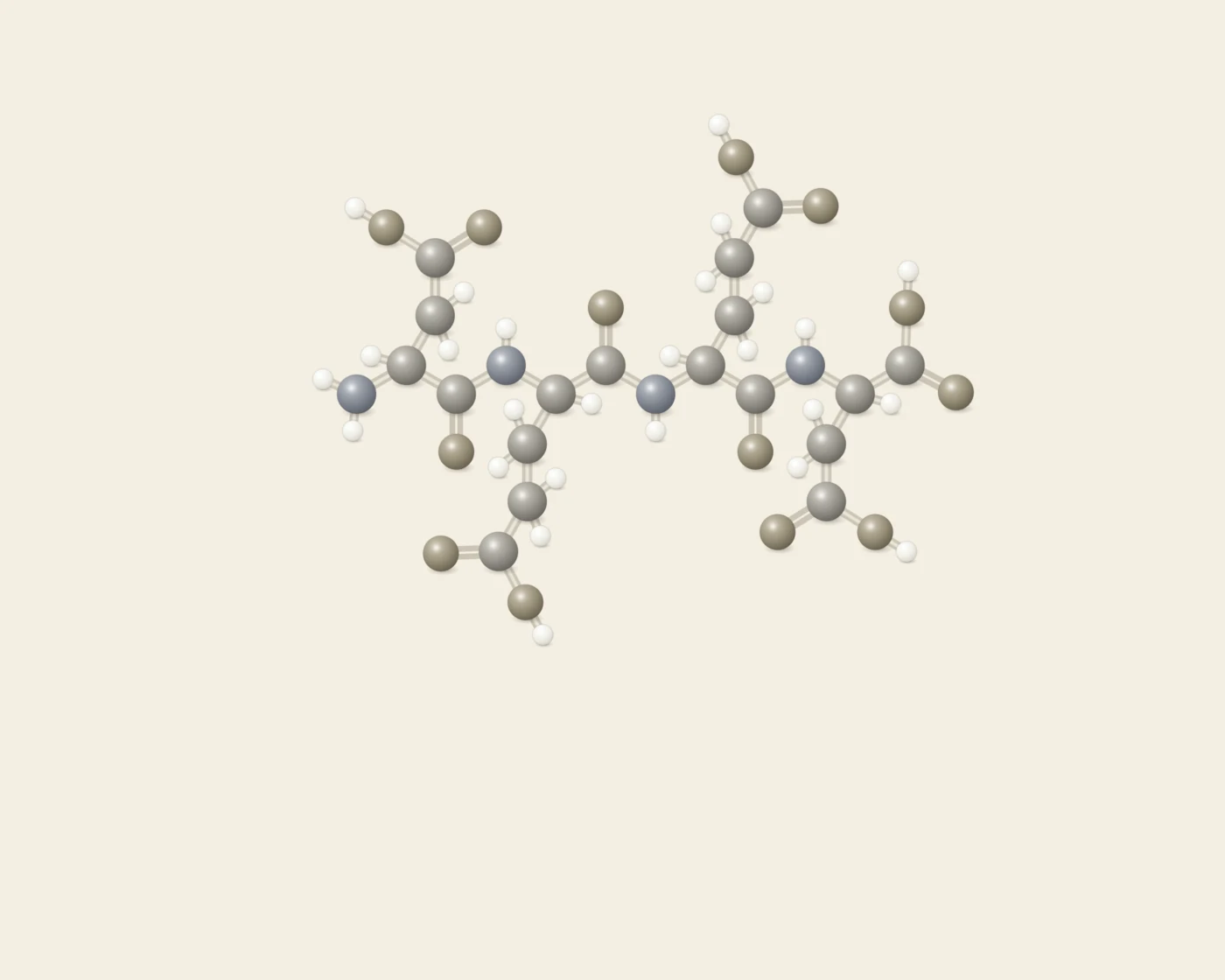
What Chitomur is
Chitomur is the oral bladder preparation in Khavinson's Cytomax line: a capsule of crude peptides extracted from the bladder tissue of young cattle, carrying the catalogue designation A-12. It is an extract, not a synthetic molecule, and it is sold for urinary comfort in later life.
What matters to you first is that Chitomur is a mixture, not a single defined chemical. It is a low-molecular-weight peptide fraction, broadly under 10 kDa, so no two batches are guaranteed identical and you cannot verify it the way you can a named sequence.
That mixture is also why the marketing can gesture at peptide science in general while staying vague about what is actually in the capsule you swallow.
Chitomur is not Vesilute
Chitomur is the crude cattle-bladder extract. Vesilute is a different product: the synthetic Cytogen bladder peptide, a single defined dipeptide made to one formula in a lab. Almost every listing blurs the two.
The two share a target organ, the bladder, and a family resemblance in the marketing. They are not the same thing, and the evidence behind each is not the same either.
When a seller lends one product's reputation to the other, you pay for a story that belongs to a different molecule. With this pair the borrowing runs the way few buyers expect: the crude extract holds the human trials, and the tidy synthetic holds none.
Swallowed, not injected: capsules and the sublingual form
You will find Chitomur as small oral capsules, with a sublingual version also sold, taken in short courses. Unlike the injectable synthetic peptides elsewhere in this market, it is swallowed.
For any oral peptide the obvious question is how much survives digestion intact, and for Chitomur that has not been answered in public data.
02 / MechanismHow Chitomur is proposed to work
One idea sits under every Cytomax product, and Chitomur is no exception. It is argued at the level of the class, and never demonstrated for the contents of this particular capsule.
The tissue-peptide hypothesis
The bioregulator theory holds that short peptides extracted from a specific organ carry signalling information relevant to that same organ in whoever takes them. For Chitomur the source tissue and the target are both the urinary bladder.
The proposal is that these peptides nudge gene expression in bladder cells towards a more youthful pattern. It is a coherent hypothesis, and for Chitomur specifically it rests on the family theory rather than on published molecular studies of this extract.
What is actually in a Chitomur capsule
Chitomur is not a defined drug with a known structure. It is a crude fraction of many peptides under roughly 10 kDa, and the active constituents have not been isolated and characterised in the way a medicine's would be.
Nobody can name the molecule doing the work, or show that it is present in the batch you were sent.
The oral survival problem for a swallowed bladder extract
Peptides are chains of amino acids, and the gut is built to break such chains down. A swallowed peptide has to survive digestion and cross into the body to act anywhere beyond the gut wall.
How much of Chitomur does that, and whether intact bladder-specific signals reach your bladder, is not something the public evidence establishes for either the capsule or the sublingual form.
03 / The evidenceWhat the Chitomur evidence actually shows
Most Cytomax extracts have no human trial tied to the specific product. Chitomur has two, both randomised, both naming the capsule.
The preclinical tiers below it are the empty ones, which is the reverse of how the evidence usually stacks up in this range.
Cell and in-vitro studies: nothing indexed
There is no PubMed-indexed cell or in-vitro study of Chitomur itself. The mechanistic case for the capsule borrows from the broader bioregulator literature, not from laboratory work on this extract.
So any dish-level story you see quoted is a class story. It was not generated with Chitomur in front of the researchers.
No animal study names Chitomur
Likewise, no animal study indexed under the Chitomur name exists on PubMed. Where the range's animal work is real, it concerns other organs and other preparations, not this bladder extract.
So the evidence Chitomur does have is human. Almost every other peptide on this site has the opposite problem: dishes and rodents, and nobody in a clinic.
Human studies on Chitomur, the real exception
Two small Russian trials tested Chitomur by name, both published in 2013 in Advances in Gerontology, both from the Saint Petersburg Institute of Bioregulation and Gerontology, the group behind the bioregulator programme.
A blind, randomised, placebo-controlled study gave Chitomur to older men with benign prostatic hyperplasia, aged 62 to 83 years, tracking urodynamic parameters, lower-urinary-tract symptoms, prostate volume and quality of life. It reported significant improvement in urination and in quality of life, holding for the month after treatment ended, with no adverse effects found.1
A randomised blind study gave Chitomur to older women with hyperactive (overactive) bladder, aged 48 to 80 years. It reported fewer urgent urination episodes and less urge incontinence, with patient-rated anxiety about symptoms easing 1.5 times faster than the symptoms themselves. No side effects were detected.2
A product-named, randomised, at least partly placebo-controlled trial is the kind of evidence the rest of the Cytomax line simply does not have. We rate this the strongest file on any oral bioregulator we cover.
Why two small Russian trials are not a settled case
Both trials are small, short, and come from the single institute that developed the drug, published in one Russian-language journal in the same year.
Neither has been independently replicated, and the women's study is described only as randomised and blind, without stating a placebo arm, so it is the men's trial that clearly carries the full placebo control.
The results are real and they point one way, but single-source, unreplicated data from the originating group is a starting point, not a settled case. You should weight it as promising, not proven.
What remains unproven
There is no independent, non-Russian, replicated trial of Chitomur. There is no cell or animal study under its name. And there is nothing establishing that the oral capsule delivers an active dose to your bladder.
What you have is two encouraging small trials from one interested institute. That is more than most bioregulators can show, and less than a proven treatment requires.
04 / Benefits by evidenceChitomur benefits: the claims, and what the evidence supports
"Bladder health" covers three separate promises here, and the trials reach only two of them. The third is doing the marketing.
Best supported. The placebo-controlled BPH trial is the strongest single piece of evidence Chitomur has, and it reported real improvement in urination and quality of life in men aged 62 to 83.1
Plausible, less firmly. The women's trial reported fewer urgency and incontinence episodes, but its abstract does not confirm a placebo arm, so read it as supportive rather than definitive.2
Least supported. Nothing in either trial speaks to slowing ageing or rebuilding bladder tissue. Claims at that altitude go well beyond what two symptom trials measured.
Chitomur's credible benefits are modest and specific: fewer urgent trips to the loo for people in their sixties and seventies. The rejuvenation language rests on nothing either trial measured.
05 / Dosage and protocolChitomur dosage and protocol
Neither published trial states a milligram dose in its abstract, so no validated figure exists to quote you. What follows is what sellers put on the box, and we are not telling you to take it.
What vendors suggest for Chitomur dosage
Chitomur is commonly sold as one to two capsules a day taken for a course of ten to thirty days, sometimes repeated once or twice a year. These figures come from vendor labels and Cytomax tradition, not from a dose-finding study.
Course length, not continuous dosing
The bioregulator convention is short repeated courses rather than daily lifelong use, and the trials describe course application rather than open-ended dosing.
The abstracts give no dose at all, so a precise Chitomur milligram protocol presented as clinically established has been reverse-engineered from a sales page.
Diagnosis before a Chitomur course
Urinary symptoms in older adults can signal conditions that need proper treatment, and a capsule is not a substitute for that. For Chitomur the dosing question matters less than the diagnosis question, which belongs with a clinician.
06 / Safety and side effectsChitomur safety and side effects
Both Chitomur trials reported no adverse effects, and the abstracts single that out as a point in the drug's favour against conventional bladder medications. We take that seriously, without taking it at face value.
Why the no-side-effects claim needs context
The trials were small, short, and designed to look for benefit over a course of weeks, not to catch rare or long-term harm. No adverse effects found in a study that size mostly tells you nothing common and dramatic happened quickly. It is not a clean bill of long-term safety.
The likelier risk: an unverified animal-tissue extract
The likelier problem is what is in the capsule rather than what the peptides do. Chitomur is an unregulated animal-tissue extract sold as a supplement, and its exact contents are not defined or verified batch to batch.
An extract from cattle tissue also carries the general questions that attach to animal-derived preparations, around sourcing, processing and consistency, none of which a glossy label settles for you.
When Chitomur is the wrong move for bladder symptoms
Bladder symptoms carry a risk the capsule does not: what you might be treating past. Blood in the urine, retention, pain or a rising prostate concern need a diagnosis, not a self-prescribed supplement.
Anyone pregnant or breastfeeding should avoid Chitomur as untested. Anyone with urinary symptoms should get them looked at first, because two small trials are a reason to be curious, not a reason to skip the appointment.
07 / SourcingWhere to buy Chitomur safely in the UK
Because Chitomur is a crude extract rather than a defined molecule, you cannot verify it the way you could a synthetic peptide. There is no single mass or sequence to check against a certificate, which puts more weight on trusting the maker.
An extract has no certificate to check
With a synthetic peptide you can demand a mass-spec identity. With an extract you are trusting the manufacturer's process and quality control, so the questions to ask are about sourcing, testing and manufacturing standards rather than a single purity number.
Know whether the box says Chitomur Cytomax or Vesilute Cytogen
Chitomur is the Cytomax extract; Vesilute is the Cytogen synthetic, and mixing them up at the checkout is where the confusion costs money. If a listing quotes crisp single-molecule peptide science, check which product is actually in the box.
Neither is wrong to buy on its own terms, but you should know which one you are holding, and not pay extract prices for a synthetic story or the reverse.
08 / ComparisonChitomur versus Vesilute, Prostamax and the rest of the range
Chitomur's natural comparison is Vesilute, the synthetic bladder dipeptide it is constantly conflated with. Chitomur is a crude multi-peptide extract with two small human trials to its name. Vesilute is a single defined molecule that, under that trade name, returns no PubMed-indexed trial at all.
Against the wider bioregulator range, Chitomur is an outlier for a surprising reason. Most of these extracts lean on class theory and animal work with no product-specific human trial, whereas Chitomur has the human trials but not the preclinical paper trail.
Prostamax is the other comparison worth making, because it is the one people mix up in practice. Prostamax is aimed at the prostate, Chitomur at the bladder, and if you are researching urinary symptoms in older men it is easy to order the wrong one.
That makes it one of the better-evidenced Cytomax capsules for its specific symptom claims, while still falling far short of a proven medicine. You can compare it against the full range on our types of bioregulator guide.
Frequently Asked Questions
What is the difference between Chitomur and Vesilute?
Chitomur is the crude cattle-bladder extract in the Cytomax line; Vesilute is a separate synthetic dipeptide in the Cytogen line. They target the same organ and get blurred together in marketing, but they are different products with different evidence behind them.
Does Chitomur actually work for bladder problems?
Two small 2013 Russian trials reported real improvement, in older men with prostate-related urinary symptoms and in older women with overactive bladder. That is genuine evidence, but it is single-institute, unreplicated, and only the men's trial was clearly placebo-controlled. Treat it as promising, not proven.
Is there any clinical evidence for Chitomur?
Yes, unusually for this range. A blind, randomised, placebo-controlled study tested it in men with benign prostatic hyperplasia aged 62 to 83, and a second randomised blind study tested it in women with hyperactive bladder aged 48 to 80. Both are small and from the institute that developed the drug.
What is the correct Chitomur dosage?
Neither published trial states a milligram dose. Vendors typically sell it as one to two capsules daily for a ten to thirty day course, repeated once or twice a year. That is a convention, not a clinically validated dose, so treat any precise protocol with caution.
How long does Chitomur take to work?
Nobody has published a figure for that. The two 2013 trials measured outcomes across a course of weeks rather than tracking when effects begin. Vendor courses of ten to thirty days are a convention, not a measured timeline, so treat any promised timeframe as invented.
Is Chitomur a capsule or an injection?
A capsule. Chitomur is an oral capsule, with a sublingual version also sold, taken in short courses. It is not an injectable, which sets it apart from the synthetic peptides marketed for reconstitution and injection.
Does Chitomur have side effects?
Both trials reported no adverse effects, which their authors highlight against conventional bladder drugs. But those studies were small and short, so absence of reported harm is not proof of long-term safety. The larger risk for most buyers is an unverified extract and an untreated underlying condition.
Is Chitomur an approved medicine in the UK?
No. Chitomur is not an approved medicine in the UK, US or EU, and is not evaluated by the MHRA, FDA or EMA. It is sold as a supplement or research product, so nobody official has checked the capsule and the risk of taking it rests with you.
Where can you buy Chitomur in the UK?
Only from specialist sellers, since it is not an approved medicine here and is sold as a supplement or research product rather than dispensed against a prescription. We set out what to ask a seller on our where to buy page.
Whoever you buy from, remember that a crude extract has no sequence or mass to check against a certificate, so the verification burden stays with you.
Should I use Chitomur instead of seeing a doctor about bladder symptoms?
No. Urinary symptoms in older adults can point to conditions that need proper diagnosis and treatment. A capsule is not a substitute for that assessment, and seeing a clinician first is the safer order to do things in.
- Gomberg VG, Ryzhak VG, Liutov RV. [Peptide geroprotector application for treatment of elderly and senile patients with prostatic hyperplasia]. Adv Gerontol. 2013;26(3):476–480. PMID: 24640697.
- Gomberg VG, Ryzhak AP, Lyutov RV. [Correction of age related bladder function decrease with peptide geroprotector in women]. Adv Gerontol. 2013;26(2):309–314. PMID: 28976156.