Bioregulator peptides are one of longevity's most intriguing ideas, and one of its least understood: short chains of two to four amino acids, first isolated from animal organs in Soviet-era Russia, said to slip inside the cell and switch genes back toward how they worked in youth.
Some of that holds up in the lab; telling it from the hype is what this page is for.
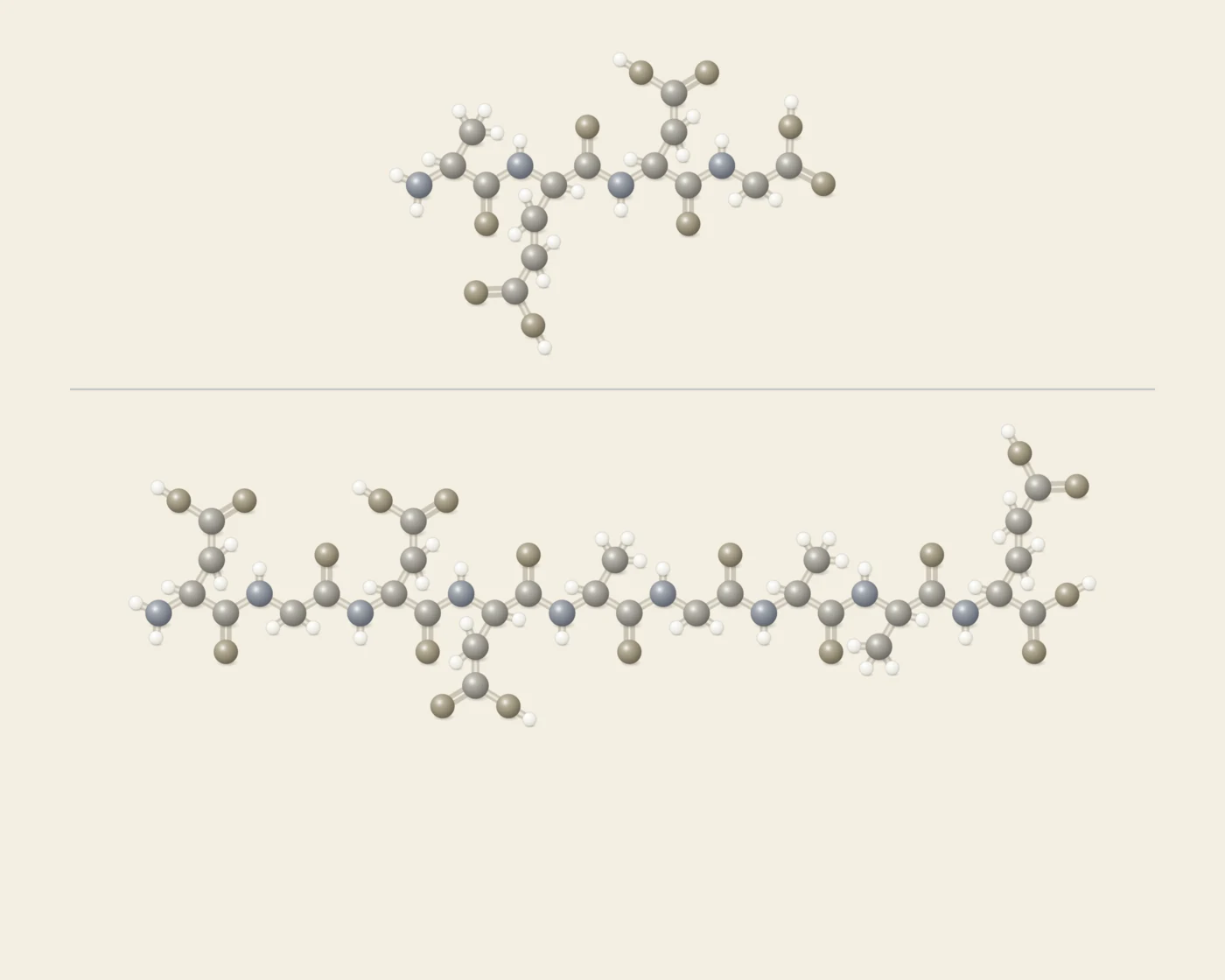 FIG.01 · ILLUSTRATION · SCALE CONTRAST
The core idea
Most peptides you read about, like BPC-157, act on the outside of a cell. They bind a receptor, fire an effect, and wear off.
Bioregulator peptides are proposed to work a level deeper: small enough to slip inside the cell and change which genes it reads. That deeper target is why they are studied for ageing rather than a quick training boost, and why the idea is worth taking seriously.
The idea binding the family together is Khavinson's "peptide bioregulation" hypothesis: that each tissue has its own regulatory peptides, and that supplying them can nudge that tissue back toward youthful function.
It is an elegant idea. In humans it is also still largely a hypothesis, and separating the part that holds up from the part that does not is the work of the sections below.
What happens inside the cell
The proposed mechanism is regulatory, not stimulant. Rather than firing a receptor from outside, these peptides are thought to bind DNA at gene-promoter regions and shift which genes a cell reads, helping a tissue restore its normal pattern of protein synthesis. Khavinson's group reports particular peptides switching specific genes on or off in laboratory models.
That is a genuine and interesting line of research. It is not the same as the popular claim that these peptides "reprogram your DNA" or act as an "epigenetic switch" in the body.
That framing takes a set of in-vitro and animal observations and presents them as an established human mechanism. They are not the same thing, and we will not pretend they are.
In cell culture, certain peptides latch onto specific gene regions and change how much protein is made. Whether that repairs tissue in a person is unknown.
Ageing cell lines show shifted gene activity under these peptides. Calling that "younger cells" in a human goes well past the data.
Each peptide is drawn from one organ and proposed to act on that same organ, the most elegant part of the whole model. The open question is whether an oral dose survives to reach that tissue, and the human evidence barely touches it.
That last one is the heart of the model: that short peptides matched to an organ can carry regulatory information to that organ. It is biologically plausible, since small peptides do have signalling roles throughout the body, and it is supported by a large volume of largely Russian-language laboratory work.
What it lacks is the independent, replicated human data that would move it from "plausible mechanism" to "demonstrated effect". When you read that a bioregulator "targets" your thymus or your brain, read it as a hypothesis being tested, not a mechanism proven to work that way in people.
The telomerase claim, and what it actually shows
The most repeated mechanistic claim concerns telomerase, the enzyme that maintains the protective caps on chromosomes. In a 2003 study, adding Epitalon to a culture of telomerase-negative human fetal fibroblasts induced telomerase activity and lengthened the telomeres.2
This is a real, citable finding, and it is a cell-culture result. It shows what the peptide can do to cells in a dish. It does not show that swallowing or injecting it lengthens telomeres, slows ageing, or extends life in a living person.
Every "boosts telomerase and extends lifespan" headline you have seen traces back, ultimately, to in-vitro work like this. That is the fact to weigh before you spend anything.
Forty years of Russian peptide research
Almost the whole field traces to one lineage: Professor Vladimir Khavinson and colleagues at the St Petersburg Institute of Bioregulation and Gerontology, building on work begun with Vladimir Morozov in the Soviet military-medical system of the 1970s. Much of it appeared only in Russian, a large part of why the West barely knows it exists.
That Cold War origin is often sold as proof, the "peptides developed for cosmonauts and soldiers" line. It is not proof. It is history, and history is not evidence of efficacy.
Two honest caveats matter more than the origin story. The great majority of the research comes from a single institutional group, is frequently published in Russian-language journals, and has seen limited independent Western replication.
A body of evidence that has not been stress-tested by researchers with no stake in the outcome is weaker than its volume suggests.
The most-cited human result is the long-term cohort in which Khavinson and Morozov followed 266 elderly people given thymus and pineal peptide preparations, reporting reduced mortality against untreated controls.1 It is the strongest human signal the category has, and it came from the group that developed the compounds, and it has never been independently replicated.
What the evidence supports, and what it does not
Here is the plain hierarchy.
Reasonably supported: that specific bioregulator peptides can influence gene expression, telomerase, and cell behaviour in laboratory and animal models. That is well documented, if mostly from one research lineage.
One real but unreplicated human signal: the long-term mortality reduction in the Thymalin and Epithalamin cohort above.1
Not supported: that oral bioregulator supplements measurably slow ageing, extend human lifespan, or reverse any condition in healthy adults. For most of the oral Cytomax and Cytogen products specifically, there are no human efficacy trials at all, a fact the marketing is careful not to mention, and one we state on every relevant page.
None of this makes bioregulators fraudulent or the research worthless. It makes them an early-stage idea being sold as a finished one. You can browse the full list of bioregulator peptides with an evidence grade on each, or read how to verify a source before buying.
Questions people ask
What are bioregulator peptides in simple terms?
They are very short peptides, often only two to four amino acids, associated with Professor Vladimir Khavinson's research, put forward as tissue-specific regulators that help a particular organ function normally. That regulatory role is a hypothesis supported mainly by laboratory and animal studies, not a proven human mechanism.
Do bioregulator peptides actually reverse ageing?
No controlled human trial shows that. Telomerase activation has been demonstrated only in cell culture,2 and the one notable long-term human study reported reduced mortality but has not been independently replicated.1 Claims that these peptides "reverse ageing" or "reprogram your DNA" overstate what the research shows.
Do oral and injectable bioregulators work the same way?
They are not interchangeable, and conflating them is the most common buyer mistake. Oral bioregulators are the Cytomax and Cytogen capsule ranges, taken in courses and sold as supplements with limited human data.
Injectables such as Thymalin and Cortexin are peptide preparations, some registered as medicines in Russia. Whether a swallowed peptide survives digestion and reaches the target tissue intact is precisely the step the human evidence does not cover.
Is the mechanism scientifically proven?
No. It is a plausible hypothesis with real laboratory support and thin, largely unreplicated human data. Interest in a mechanism is not evidence that it helps you, and we mark which is which on every peptide page.
One last thing, said plainly. What often arrives in the post is a vial with a Cyrillic label, no certificate of analysis, and a powder you mix yourself.
Before you put that into your body on the strength of a thirty-person study, the person to ask is a doctor who knows your history. Not a vendor, and not us.
- Khavinson VKh, Morozov VG. Peptides of pineal gland and thymus prolong human life. Neuro Endocrinol Lett. 2003;24(3-4):233-240. PMID: 14523363. Cohort of 266 elderly persons followed 6 to 8 years; Thymalin and/or Epithalamin associated with reduced mortality against control. Single-group, unreplicated.
- Khavinson VKh, Bondarev IE, Butyugov AA. Epithalon peptide induces telomerase activity and telomere elongation in human somatic cells. Bull Exp Biol Med. 2003;135(6):590-592. PMID: 12937682. In-vitro study in telomerase-negative human fetal fibroblasts.