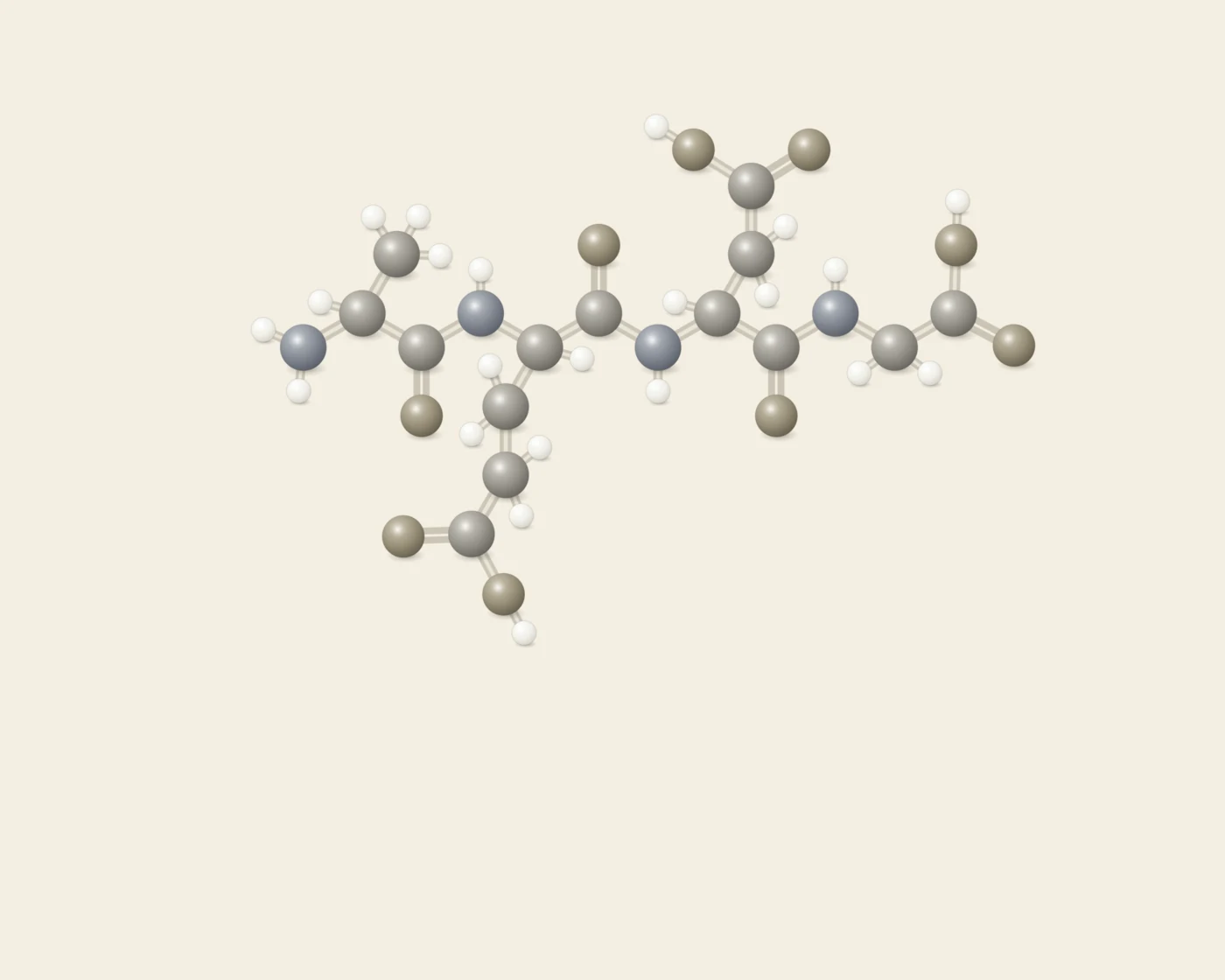
What the Epitalon peptide is
Epitalon (also spelled Epithalon, and sold under its sequence AEDG) is a synthetic tetrapeptide: four amino acids, alanine-glutamate-aspartate-glycine, made to a single defined formula in a lab. It is the flagship of the bioregulator range, and the most oversold compound in it.
It matters to you, before anything else, that Epitalon is a defined chemical rather than an organ extract. That is why it is cheap to make, consistent from batch to batch, and easy to study in a dish.
It is also why the marketing can point to real laboratory papers, and then stretch them a very long way. The papers exist. The distance travelled from them is the problem.
Epitalon is not the same as epithalamin, the pineal extract
Almost every sales page blurs these two. Epitalon is the synthetic tetrapeptide. Epithalamin (sometimes "Epithalon extract") is its parent: a crude peptide preparation extracted from the pineal glands of cattle, developed in Leningrad by Vladimir Khavinson's group in the 1980s.
Most of the human data attached to "Epitalon" was actually generated with epithalamin, the extract, not the synthetic peptide you are likely to be sold. When a vendor lends the extract's clinical history to the synthetic capsule, they are quietly swapping one product for another.
Oral capsules or injectable vials
You will find Epitalon two ways: as a lyophilised powder for reconstitution and subcutaneous or intramuscular injection, and as oral capsules in the retail bioregulator lines.
The injectable is what the research protocols used. For an oral peptide, the obvious question is how much survives the gut intact, and for Epitalon that has not been properly answered.
02 / MechanismHow Epitalon is proposed to work
Two mechanisms are claimed for Epitalon, and they are not equally well grounded. One is the telomerase headline. The other is a quieter pineal story that carries more of the weight.
Telomerase activation: the headline mechanism
Telomeres are protective caps on the ends of chromosomes that shorten each time a cell divides. Telomerase is the enzyme that rebuilds them. The claim is that Epitalon switches telomerase back on, letting cells rebuild their telomeres and keep dividing.
In cultured human cells this is real: Epitalon induced telomerase (hTERT) activity and lengthened telomeres in human fibroblasts.1 A separate study reported that treated cells overcame the Hayflick limit, the normal ceiling on how many times a somatic cell divides.2
The claim that the AEDG peptide binds DNA
The proposed upstream mechanism is that these short peptides slip into the cell and bind specific sequences in the DNA double-helix, behaving a little like transcription factors and shifting which genes are read.3,4 This is the bioregulator hypothesis in miniature, and Epitalon is its worked example.
In a dish the mechanism holds up. The leap the marketing makes is from "reactivates telomerase in a fibroblast culture" to "lengthens your telomeres and extends your life." That is a leap across several unproven steps, not a single stride.
The pineal gland and melatonin strand
The quieter, better-grounded mechanism is pineal. Epitalon's parent came from the pineal gland, which sets melatonin rhythm and the body's circadian clock, and pineal output falls with age. The melatonin story is where Epitalon has its most credible human signal, and, not coincidentally, its least dramatic claims.
03 / The evidenceWhat the Epitalon evidence actually shows
The evidence is uneven and the marketing flattens it. It is strongest in cells, thinnest in people, and, crucially, generated mostly with the extract rather than the peptide most buyers end up holding.
Epitalon in cell and in-vitro studies
Khavinson and colleagues reported that Epitalon induced telomerase activity and elongated telomeres in cultured human foetal fibroblasts.1 This is the foundational finding the whole longevity pitch rests on.
A follow-up reported that treated somatic cells could divide beyond their usual Hayflick ceiling.2 Interesting in a dish; a long way from an intact organism.
Al-Dulaimi and Thomas, a group unconnected to Khavinson, reported that Epitalon increased telomere length in human cell lines, through telomerase upregulation or the ALT pathway.5 A later correction was issued to that paper.6 We rate it the strongest item in Epitalon's file: the one result not produced by the peptide's own developers.
Take the cell data at face value and it is a coherent, now-replicated in-vitro story. What it is not is evidence that swallowing or injecting Epitalon lengthens telomeres in your body.
Animal studies: the SHR mouse data
Anisimov and Khavinson gave Epitalon to female SHR mice and tracked ageing biomarkers, lifespan and spontaneous tumours.7 What it actually found: it did not raise mean lifespan much, gave a modest gain in maximum lifespan, and notably reduced spontaneous tumour incidence. A survival-tail and anti-tumour effect, not wholesale life extension.
That tumour result cuts against the usual fear that switching on telomerase should raise cancer risk. In these mice it did the opposite. One mouse strain is not a person, but it is a real data point in Epitalon's favour and against the simplest cancer worry.
Human studies on Epitalon: read the small print
One caveat reframes everything below: nearly all the human work used epithalamin, the pineal extract, not synthetic Epitalon, and nearly all of it came from the originating St Petersburg group, unblinded and not independently replicated.
In elderly subjects, epithalamin restored a more youthful circadian melatonin rhythm.8 This is Epitalon's most credible human signal, and it underlies the sleep effects users describe.
Epithalamin was reported as geroprotective in elderly people with accelerated ageing, improving several physiological markers.9 Small, open-label, single-group.
Korkushko and Khavinson followed elderly patients given the pineal peptide over 15 years and reported lower mortality than untreated controls.10 It is the most-cited "Epitalon extends life" figure. It is also unblinded, non-randomised, run by the group that developed the drug, and it used the extract.
Epitalon was reported to improve retinal function in retinitis pigmentosa, a degenerative eye disease.11,12 A specific and consistent line of work, though niche and again single-source.
What remains unproven
Set the hype aside and the gaps are clear. There is no randomised, blinded, independently run human trial showing that synthetic Epitalon lengthens telomeres, slows ageing, or extends lifespan.
The strongest human data belongs to the extract, not the synthetic peptide most people buy, and almost none of it has been replicated outside its home institute.
None of that makes the compound worthless. It leaves something with a real, now-independently-replicated cell mechanism, a modest supportive animal result, a credible human melatonin signal, and a longevity headline the human evidence has not earned.
04 / Benefits by evidenceEpitalon benefits: the claims, and what the evidence supports
Epitalon is sold as one promise with three claims folded into it. Sleep, telomeres and lifespan carry very different amounts of human evidence, and the price on the vial is the same for all three.
Most plausible. It follows directly from the pineal-melatonin mechanism and the 2004 human data, and it is the effect users most consistently report.
Real in cells, now independently replicated, but unproven in humans. Buying Epitalon "for your telomeres" is buying a dish result, not a demonstrated outcome in you.
Least supported. It rests on one unblinded 15-year cohort of the extract from the originating group. Treat "Epitalon extends lifespan" as a hypothesis, not a finding.
Life extension, the reason most people buy Epitalon, rests on one unblinded cohort of the extract. Better sleep, which nobody puts in the headline, has a human melatonin study behind it.
05 / Dosage and protocolEpitalon dosage and protocol
No dose-finding trial has ever been run on synthetic Epitalon. Every figure below is convention or vendor guidance, so read it as what people do, not as a validated human dose or a schedule to copy.
Doses used in the Khavinson research
The Khavinson group's studies of epithalamin typically used short intramuscular courses, on the order of 10 mg daily for five to ten days, sometimes repeated once or twice a year over a period of years. The lifespan follow-up repeated courses annually rather than dosing continuously.
Typical vendor protocols for synthetic Epitalon
Sold as the synthetic peptide, Epitalon is commonly injected at roughly 5 to 10 mg per day, subcutaneously or intramuscularly, in ten to twenty day courses run one to three times a year.
These figures come from vendor labels and community tradition. Treat any page presenting them as "the clinically proven dose" as converting a convention into a claim.
Oral versus injected protocols
Oral Epitalon capsules are marketed heavily because they are easy to sell, but a four-amino-acid peptide faces digestion in the gut, and how much survives to act systemically is unestablished.
If a protocol matters to you, understand that the injectable route is the one the studies used, and the oral route is the one the evidence has not validated.
06 / Safety and side effectsEpitalon safety and side effects
The small studies that exist reported Epitalon and epithalamin as well tolerated, with no serious adverse events noted. Every one of those studies was hunting for benefit.
Why "no side effects reported" is misleading
"No side effects reported" for a compound barely studied for harm mostly tells you nobody looked hard or long. A handful of short courses in small groups cannot detect a rare reaction, and nothing here followed anyone for years.
The risks that are actually likely
The likelier danger sits in the vial rather than the molecule. An unregulated injectable carries risks of endotoxin contamination, bacterial contamination, mislabelling and underdosing, and reconstituting a powder yourself adds a sterility risk. What is in the vial is not guaranteed.
On the theoretical side, chronically switching on telomerase raises a reasonable cancer question, since cancer cells exploit telomerase. Against that: the SHR-mouse study found fewer spontaneous tumours, not more. Long-term cancer risk in humans is simply unknown, and we would treat any vendor who says otherwise as guessing.
Who should not use Epitalon
Anyone who is pregnant or breastfeeding, since it is untested there; anyone with an active or recent cancer, given the telomerase question; and, frankly, anyone dosing without a clinician who knows their history.
Injecting anything is a decision with a needle on the end of it. Before you make that one on the strength of a fibroblast culture, put it to a doctor who knows your cancer history. That is one conversation we cannot have on your behalf.
07 / SourcingWhere to buy Epitalon safely in the UK
Epitalon's popularity and low production cost make it one of the most counterfeited peptides in this market. Because it is a single defined sequence, you can at least verify it, which is more than you can say for the crude extracts elsewhere in the range.
How to verify Epitalon purity with a COA
Insist on a certificate of analysis showing identity and purity by HPLC and mass spectrometry, with the sequence and mass matching Ala-Glu-Asp-Gly. Prefer suppliers who publish third-party testing, and for injectables ask about sterility and endotoxin testing. Epitalon is cheap to synthesise, so a price far below the market says something about purity, not value.
Synthetic AEDG versus epithalamin extract products
Check which product you are actually buying. If a listing leans on the elderly-cohort or lifespan research, that work used epithalamin, the extract, so a synthetic Epitalon vial is not the thing that was studied.
Neither is wrong to buy. But we would not pay an extract's clinical premium for a synthetic vial, and a listing citing the 15-year cohort is asking you to do exactly that.
08 / ComparisonEpitalon versus Pinealon and epithalamin
Epitalon is often shelved next to Pinealon, another short synthetic peptide from the same programme aimed at the brain. Epitalon has the far richer evidence base of the two, including the telomerase work and the human melatonin data, while Pinealon rests on thinner cell and animal studies.
Against its own parent, epithalamin, Epitalon trades the extract's messy composition for a clean, consistent molecule, but inherits a human evidence base that was largely built on the extract. We compare the two synthetic peptides in depth on our Epitalon vs Pinealon guide.
Frequently Asked Questions
Two things drive almost every Epitalon question: whether the telomere result transfers from a dish to a person, and whether the human research used the peptide or the extract.
Does Epitalon lengthen telomeres in humans?
Not that anyone has shown. Telomere lengthening is demonstrated in cultured human cells, and independently replicated in 2025, but no human study has shown that injecting or swallowing Epitalon lengthens telomeres in your body.
What is the difference between Epitalon and Epithalon?
"Epithalon" is just an alternate spelling of Epitalon, the synthetic tetrapeptide. Epithalamin is different: the crude pineal extract it was derived from. Most human "Epitalon" studies actually used epithalamin, so the two are worth keeping apart.
How much Epitalon do you inject per day?
There is no validated human dose. Vendors of the synthetic peptide commonly suggest 5 to 10 mg per day by injection in short courses; research with the extract used courses around 10 mg daily for several days. These are conventions, not clinically established doses.
How long should an Epitalon cycle be?
There is no established cycle length. Vendors of the synthetic peptide commonly run ten to twenty day courses, one to three times a year; the epithalamin research used five to ten day courses, repeated once or twice a year over a period of years. Both are convention, not validated protocol.
Do oral Epitalon capsules work as well as injections?
On the evidence, no. The studies used injection, and how much of a four-amino-acid peptide survives digestion is unestablished, so the oral route is the one the evidence has not validated.
How do you reconstitute a 10mg vial of Epitalon?
The usual practice is bacteriostatic water run slowly down the vial wall, swirled rather than shaken, then kept refrigerated. That is convention, not a validated procedure. It is also where the risk shifts to you: handling it yourself adds a sterility risk, and nothing guarantees what was in the vial to begin with.
Does Epitalon extend lifespan?
Not on any evidence that would satisfy a sceptic. The lifespan claim rests on one unblinded 15-year cohort of the extract from the originating group, plus a modest maximum-lifespan gain in one mouse strain. Treat it as a hypothesis, not a proven outcome.
Does Epitalon cause cancer?
Nobody knows, and anyone who tells you otherwise is guessing. Cancer cells do rely on telomerase, so the question is fair. In the SHR-mouse study Epitalon reduced spontaneous tumours, which cuts against the simple worry, but long-term cancer risk in humans is unstudied. If you have a cancer history, ask your doctor.
Is Epitalon FDA approved or legal in the UK?
Epitalon is not an approved medicine in the UK, US or EU, and is not evaluated by the MHRA, FDA or EMA. It is sold as a research compound or supplement, and buying and using it is unregulated and at your own risk.
How do you spot fake Epitalon?
Ask for a certificate of analysis with HPLC and mass-spec identity matching Ala-Glu-Asp-Gly, prefer third-party-tested suppliers, and be suspicious of prices far below the market. For injectables, ask about sterility and endotoxin testing.
- Khavinson VKh, Bondarev IE, Butyugov AA. Epithalon peptide induces telomerase activity and telomere elongation in human somatic cells. Bull Exp Biol Med. 2003;135(6):590–592. PMID: 12937682.
- Khavinson VKh, Bondarev IE, Butyugov AA, Smirnova TD. Peptide promotes overcoming of the division limit in human somatic cells. Bull Exp Biol Med. 2004;137(5):503–506. PMID: 15455129.
- Khavinson VKh, Shataeva LK, Chernova AA. Effect of regulatory peptides on gene transcription. Bull Exp Biol Med. 2003;136(3):288–290. PMID: 14666197.
- Fedoreyeva LI, Kireev II, Khavinson VKh, Vanyushin BF. DNA double-helix binds regulatory peptides similarly to transcription factors. Neuro Endocrinol Lett. 2005. PMID: 15990728.
- Al-Dulaimi S, Matta C, Thomas R, et al. Epitalon increases telomere length in human cell lines through telomerase upregulation or ALT activity. Biogerontology. 2025. PMID: 40908429.
- Correction: Epitalon increases telomere length in human cell lines through telomerase upregulation or ALT activity. Biogerontology. 2025. PMID: 41240216.
- Anisimov VN, Khavinson VKh, Provinciali M, et al. Effect of Epitalon on biomarkers of aging, life span and spontaneous tumor incidence in female Swiss-derived SHR mice. Biogerontology. 2003;4(4):193–202. PMID: 14501183.
- Korkushko OV, Khavinson VKh, Shatilo VB, Antonyuk-Shcheglova IA. Effect of peptide preparation Epithalamin on circadian rhythm of epiphyseal melatonin-producing function in elderly people. Bull Exp Biol Med. 2004;137(4):389–393. PMID: 15452611.
- Korkushko OV, Khavinson VKh, Shatilo VB, et al. Geroprotective effect of Epithalamine in elderly subjects with accelerated aging. Bull Exp Biol Med. 2006;142(3):356–359. PMID: 17426848.
- Korkushko OV, Khavinson VKh, Shatilo VB, Antonyuk-Shcheglova IA. Peptide geroprotector from the pituitary gland inhibits rapid aging of elderly people: results of 15-year follow-up. Bull Exp Biol Med. 2011;151(3):366–369. PMID: 22451889.
- Khavinson VKh, Razumovsky M, Trofimova S, et al. Pineal-regulating tetrapeptide epitalon improves eye retina condition in retinitis pigmentosa. Neuro Endocrinol Lett. 2002;23(4):365–368. PMID: 12195242.
- Khavinson VKh, Proniaeva VE, Linkova NS, Trofimova SV. [Molecular-physiological aspects of peptide regulation of the function of the retina in retinitis pigmentosa]. Fiziol Cheloveka. 2014. PMID: 25272779.