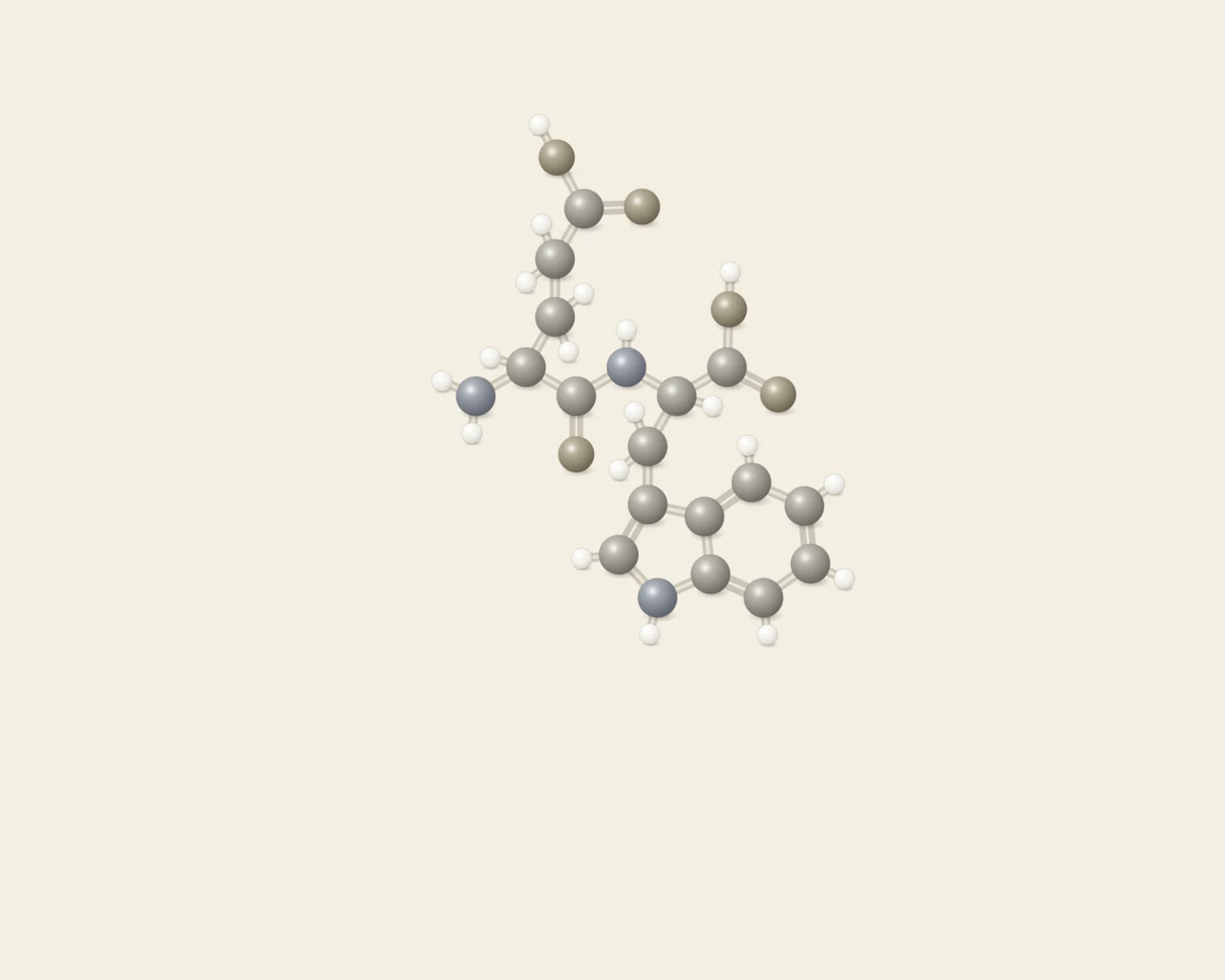
What Thymogen is
Thymogen is a synthetic dipeptide: just two amino acids, L-glutamic acid joined to L-tryptophan, written Glu-Trp or EW. A dipeptide is about as small as a peptide gets, which is exactly why it can be made to a single defined formula in a lab rather than pulled from tissue batch by batch.
It belongs to the Khavinson family of peptide bioregulators, and its target system is the immune one, the thymus in particular. In Russia it is a registered pharmaceutical, sold as an immunocorrector for states of suppressed immunity.
That registration does not travel. In the UK, US and EU, Thymogen has no MHRA, FDA or EMA authorisation, so what reaches you is a grey-market vial, not a licensed medicine.
Thymogen is the fragment, Thymalin is the parent
Researchers took the calf-thymus extract Thymalin, separated it by reverse-phase HPLC, isolated L-Glu-L-Trp as an active immunomodulatory fragment, then synthesised that dipeptide as a stand-alone drug.1 Almost every sales page blurs that lineage.
So Thymogen is the clean, defined molecule carved out of the messy extract, which is a real gain in purity and consistency.
The Thymalin evidence trap you are being walked into
Because Thymogen came out of Thymalin, vendors routinely borrow Thymalin's human research and pin it to Thymogen as though the two were interchangeable. They are not.
The extract is where most of the actual human data sits, including a 266-person elderly cohort followed for six to eight years.2 The clean dipeptide is the newer, thinner-studied one, and neither evidence base transfers to the other.
02 / MechanismHow Thymogen is proposed to work
The claim for Thymogen is immunomodulation rather than blunt stimulation: the idea is that it nudges a suppressed immune system back toward normal, rather than simply revving everything up. Unlike most of this field, the mechanism story here has some published substance to it.
T-cell differentiation and cytokines
In the original comparative work, both Thymalin and synthetic Thymogen activated T-cell differentiation and T-cell recognition of peptide-MHC complexes, and shifted the cytokine output of blood lymphocytes, including interleukin-2 and interferon.1
The same paper reported that the synthetic dipeptides activated neutrophil chemotaxis and phagocytosis, the front line of the innate response. Neutrophils, cytokines and T-cell recognition make a chain you can follow, which is more than several peptides in this range offer.
The effect runs through the thymus
In rats, Thymogen's downstream hepatoprotective effect disappeared once the animals were thymectomised, which points to the thymus and immune system as the route the peptide acts through, not a direct action on the target organ.3
It can dial immunity down, not only up
The word modulator earns its place in one animal result. When low-dose radiation over-stimulated the immune systems of mice, Thymogen significantly reduced that radiation-induced immunostimulation.4
That is the strongest thing you can say for the mechanism: in animals Thymogen pushes an abnormal immune response back toward baseline in either direction. What none of it tells you is how much of that translates into a healthy person injecting the peptide at home.
What the Thymogen evidence actually shows
The marketing flattens three different piles of evidence into one: what animals showed, what people given Thymogen itself showed, and what the same molecule did in Western oncology trials.
Animal and infection studies on Thymogen
In guinea pigs infected with Yersinia enterocolitica, Thymogen at 10 micrograms per kg for four days produced an immunoregulatory effect, enhanced nonspecific resistance and reduced spread of the infective agents.5 A clean infection model, and one of the tidier animal signals.
Against influenza A (H3N2) in mice, glutamyl-tryptophan was dosed at 0.1, 10 and 1000 micrograms per kg for five days. Alone it was weaker than rimantadine; combined with glycyrrhizic acid it cut death by 75 to 79 percent.6 Read the small print: the win was the combination, not Thymogen solo.
A recent Kursk group tested Thymogen and D-alanine analogues in carbon-tetrachloride liver injury, reporting antioxidant and reparative effects, with the analogues outperforming Thymogen itself.7 Useful as recent, non-originator lab work, though still animal and still preliminary.
Across infection, radiation and toxic injury the animal work tells one consistent immunomodulatory story. None of it says a healthy person will feel anything.
Human studies of Thymogen itself
This pile belongs to the molecule you would buy. It is small and mostly Russian-language, and we rate one entry in it above anything most bioregulators can show.
A double-blind, randomised, placebo-controlled study gave elderly abdominal-cancer surgery patients intranasal Thymogen once a day for seven days before surgery, and reported restored cellular-immunity parameters versus saline placebo.8 This is the one properly controlled human trial of Thymogen.
In type 1 diabetics with secondary immunodeficiency, Thymogen was reported to remove signs of that deficiency through activation of T-lymphocyte differentiation, with a clinical effect in 94.4 percent and a laboratory effect in 83.3 percent of patients.9 Striking numbers, but open-label and uncontrolled.
Adding Thymogen at 0.5 to 0.8 mg per course to standard care in 48 acute-pancreatitis patients was reported to correct T-cell immune deficiency and improve clinical dynamics.10 Again single-arm, again positive, again small.
One small blinded trial plus a scatter of open-label case series is a real human base. We rate it well short of the deep clinical record vendors imply, and almost none of it is independently replicated outside Russia.
The same dipeptide in Western trials, under the name IM862
No sales page shows you this strand, and it cuts both ways. The identical dipeptide was developed in the West as IM862, also called oglufanide, and taken into blinded, placebo-controlled oncology trials on an antiangiogenic rationale.
A 24-week randomised, double-blinded, placebo-controlled phase III trial enrolled 202 HIV-positive patients, 104 on IM862 and 98 on placebo, at 5 mg intranasally every other day. IM862 was not superior to placebo and may have accelerated time to progression.11
A phase II trial of IM862 in 25 metastatic renal-cell-carcinoma patients, at 20 mg intranasally three times daily, produced no objective responses, though plasma VEGF fell.12 The authors advised against developing it further at that dose.
So the clean molecule does have proper Western randomised data. It is just data for a different question, cancer, and it was negative. That does not condemn the immune use, but it should end any claim that Glu-Trp is unstudied or magically potent.
What the vendors are really quoting is Thymalin
When a listing waves a big human longevity or immunity result at you, trace it. The famous elderly-cohort work followed 266 people over six to eight years and reported large mortality reductions, up to a 4.1-fold drop in one arm.2
That study used Thymalin, the extract, alongside Epithalamin, not Thymogen the dipeptide. Borrowing its numbers for a Thymogen vial is lending one product the clinical history of another.
04 / Benefits by evidenceThymogen benefits: the claims, and what the evidence supports
Read the rows below in the order a listing never does: sick patients first, healthy adults second, longevity last. That is the order of the evidence, and it runs from a real clinical signal down to a headline belonging to a different product.
Most supported. A coherent mechanism, consistent animal data, and one blinded human trial in surgical patients all point the same way. This is Thymogen's real signal, and it sits in sick people, not well ones.
Plausible but unproven. It extrapolates from immunocompromised patients to you, which is a leap. The respiratory-illness reductions people cite came from the Thymalin extract cohort, not Thymogen.
Least supported. Thymogen has no lifespan data of its own. The longevity headline is entirely Thymalin's, and even that is open-label work from the originating institute.
Immune correction in ill patients carries the evidence, and it is the quietest line on any listing. The longevity headline carries nothing that belongs to this molecule.
05 / Dosage and protocolThymogen dosage and protocol
None of this is a recommendation to dose yourself. No consumer dose-finding trial exists, so most figures in circulation are label convention rather than validated human doses.
Doses that appear in the research
The controlled surgical trial used a short intranasal course, once a day for seven days before surgery.8 The pancreatitis series used 0.5 to 0.8 mg across a treatment course.10 Animal infection work used microgram-per-kg dosing over four to five days.5,6
What those share is a pattern: small amounts, given as short courses tied to an illness, not open-ended daily self-dosing for wellness.
Injectable versus intranasal Thymogen
Thymogen is used as an intramuscular injectable and as an intranasal solution or spray. It is not one of the oral Cytomax-style capsules, so if a vendor offers you Thymogen capsules, treat that as a flag that you may be looking at a different or relabelled product.
The intranasal route is the one the blinded human trial and the Western oncology trials actually used, so injection is not the serious option by default.
06 / Safety and side effectsThymogen safety and side effects
The available studies reported Thymogen as well tolerated, and the Western IM862 renal-cell trial specifically recorded no drug-related grade 2 or 3 toxicities.12 That is more reassuring than usual for this field, and it covers weeks rather than years.
Why "well tolerated" is not the same as "safe for you"
Those trials were short, small, and run in patients under supervision. Good tolerability over a few weeks in a monitored trial tells you little about repeated self-administered courses over years, which is what home use looks like and which nobody has studied.
The risks that are actually likely
The vial is likelier to harm you than the dipeptide is. An unregulated injectable or nasal solution carries risks of bacterial and endotoxin contamination, mislabelling and underdosing, and reconstituting a powder yourself adds a sterility risk. What is in the vial is not guaranteed to be what the label says.
There is a specific immunological caution too: a drug that modulates immune function is not obviously wise to self-administer if you have an autoimmune condition, are immunosuppressed, or take immune-active medication.
Who should not use Thymogen
Anyone pregnant or breastfeeding, since it is untested there; anyone with an autoimmune or active immune-mediated condition; and anyone dosing without a clinician who knows their history. Before an unlicensed immunomodulator goes into your body, ask a doctor who knows your immune history. That is not a vendor's call, and not one we can make.
07 / SourcingWhere to buy Thymogen safely in the UK
Thymogen has one sourcing advantage over the extracts elsewhere in this range: it is a single defined sequence, so it can actually be verified. A crude tissue extract cannot be checked the same way.
How to verify Thymogen purity before you buy
Insist on a certificate of analysis showing identity and purity by HPLC and mass spectrometry, with the mass matching the Glu-Trp dipeptide. Published third-party testing counts for more than a supplier's own paperwork, and an injectable needs sterility and endotoxin results too. A price far below the market is a warning.
Watch the Thymalin swap at the point of sale
The evidence confusion has a sourcing twin. Some listings describe a Thymogen product but cite Thymalin's research, or use the names loosely across the same page.
If the marketing leans on the elderly-cohort longevity data, that work was the extract, so a Thymogen dipeptide vial is not the thing that was studied. Know which molecule is in your hand before you pay for the other one's reputation.
08 / ComparisonThymogen vs Thymalin: the trade you are making
Thymogen and Thymalin sit at opposite ends of one story. Thymalin is the older calf-thymus extract with the deeper human record, including the long elderly cohort, but it is a variable biological mixture.
Thymogen is the clean synthetic fragment isolated from it: a defined molecule with a mechanism you can name, but a much thinner human base of its own.1,2
Neither is strictly better; they are different trades between consistency and clinical history. We set the two side by side on our Thymalin vs Thymogen guide, and you can place both against the wider family on our peptide bioregulator types overview.
Frequently Asked Questions
What is the difference between Thymogen and Thymalin?
Thymalin is the crude calf-thymus extract; Thymogen is the single Glu-Trp dipeptide isolated from it and then made synthetically. Most of the big human immunity and longevity data belongs to the extract, not the dipeptide, so the two are worth keeping firmly apart.
Is there any human clinical evidence for Thymogen?
A little. There is one double-blind, placebo-controlled trial in elderly surgical patients, plus several small open-label Russian case series in conditions like diabetes and pancreatitis. That is a genuine base, but it is thin and largely unreplicated outside Russia.
Is Thymogen the same as IM862 or oglufanide?
Yes. IM862, or oglufanide, is the same L-Glu-L-Trp dipeptide developed in the West for cancer. It went through blinded, placebo-controlled phase II and III oncology trials, which were negative for their cancer endpoints. It matters because it shows the molecule is not unstudied, just unproven for the uses vendors push.
Is Thymogen taken orally, as a nasal spray or by injection?
As an intramuscular injection or an intranasal solution or spray. The controlled human trial and the Western oncology trials both used the intranasal route. Thymogen is not sold as an oral capsule, so capsules marketed under the name should make you pause.
What is the correct Thymogen dosage?
There is no validated consumer dose. Studies used short courses: once daily intranasally for a week before surgery, or fractions of a milligram across a treatment course in patients. Wellness dosing figures come from vendor labels, not trials.
Does Thymogen boost your immune system?
Unproven. Its real signal is correcting immune deficiency in ill patients, not boosting a healthy immune system. The reduced-infection figures often quoted came from the Thymalin extract cohort, not from Thymogen.
Is Thymogen legal in the UK, and is it approved by the MHRA or FDA?
It is a registered pharmaceutical in Russia but has no MHRA, FDA or EMA approval in the UK, US or EU. Outside Russia it is sold as a research compound, so nobody regulates what arrives or what you do with it.
Does Thymogen have side effects?
Short trials reported no consistent side effects and described it as well tolerated, and one Western trial logged no significant drug toxicity. That is not the same as proven safe for repeated home use, and an immunomodulator is a poor choice to self-dose if you have an autoimmune condition. Ask a doctor first.
Is Thymogen the same as Thymosin alpha-1?
No. Thymogen is the two-amino-acid Glu-Trp dipeptide. Thymosin alpha-1 is a different thymic peptide, 28 amino acids long, sold as thymalfasin. Products sold under names that run the two together, such as Thymogen Alpha-1, blur that distinction, so check the sequence a seller states rather than trusting the brand.
Is Thymogen the same as Thymagen?
Yes. Thymagen is an alternate spelling of the same Glu-Trp thymus dipeptide, used by some vendors and across much of the English-language web. Other products borrow the Thymogen name for entirely different contents, so match the stated sequence rather than the label.
- Morozov VG, Khavinson VK. Natural and synthetic thymic peptides as therapeutics for immune dysfunction. Int J Immunopharmacol. 1997;19(9–10):501–505. PMID: 9637345.
- Khavinson VKh, Morozov VG. Peptides of pineal gland and thymus prolong human life. Neuro Endocrinol Lett. 2003;24(3–4):233–240. PMID: 14523363.
- Okovityĭ SV, Gaĭvoronskaia VV. [Immune mechanisms of hepatoprotector effects of etomersol and thymogen]. Eksp Klin Farmakol. 2002;65(3):44–46. PMID: 12227096.
- Sharetskiĭ AN, Surinov BP, Abramova MR. [Effect of low doses of ionizing radiation on thymus-dependent humoral immune response and the polyclonal activation of B lymphocytes]. Radiats Biol Radioecol. 2000;40(2):168–172. PMID: 10819040.
- Iushchuk ND, Tseneva GIa, Alenushkina TV, Kuliashova LB. [The efficacy of using thymogen in an experimental infection caused by Yersinia enterocolitica]. Zh Mikrobiol Epidemiol Immunobiol. 1995;(3):106–108. PMID: 7660690.
- Smirnov VS, Zarubaev VV, Anfimov PM, Shtro AA. [Effect of a combination of glutamyl-tryptophan and glycyrrhizic acid on the course of acute infection caused by influenza (H3N2) virus in mice]. Vopr Virusol. 2012;57(3). PMID: 22905423.
- Chulanova AA, Smakhtin MY, Bobyntsev II, et al. Reparative and antioxidant effects of new analogues of immunomodulator Thymogen in experimental model of liver damage. Bull Exp Biol Med. 2023. PMID: 37861903.
- Smirnov VS, Petlenko SV, El'tsin SS. [Application thymogen for preoperative preparation of elderly patients with tumor processes in abdominal cavity]. Adv Gerontol. 2011;24(2):278–284. PMID: 21957588.
- Zhuk EA, Galenok VA. [Thymogen in the treatment of type-1 diabetes mellitus]. Ter Arkh. 1996;68(10):12–14. PMID: 9026934.
- Saĭdakhmedova ZT. [Immunomodulating activity of thymogen in acute pancreatitis]. Vopr Pitan. 2000;69(6):35–36. PMID: 11452372.
- Noy A, Scadden DT, Lee J, et al. Angiogenesis inhibitor IM862 is ineffective against AIDS-Kaposi's sarcoma in a phase III trial. J Clin Oncol. 2005;23(5):990–998. PMID: 15598977.
- Deplanque G, Madhusudan S, Jones PH, et al. Phase II trial of the antiangiogenic agent IM862 in metastatic renal cell carcinoma. Br J Cancer. 2004;91(9):1645–1650. PMID: 15354209.