What Sigumir is
Sigumir is the cartilage-and-bone entry in Khavinson's Cytomax range: a crude peptide complex extracted from the cartilage and bone tissue of young animals, sold as an oral capsule and given the catalogue code A-4.1 It is aimed at joints, spine and the wear-and-tear side of ageing.
It matters to you, before anything else, that Sigumir is an organ extract rather than a defined molecule. It is a mixture of low-molecular-weight peptides pulled from tissue, not a single sequence you can name, weigh or verify.
An extract cannot be pinned to a formula, so it cannot be studied as itself, and no certificate can confirm it. That is why the evidence below keeps belonging to something else.
Sigumir is not Cartalax
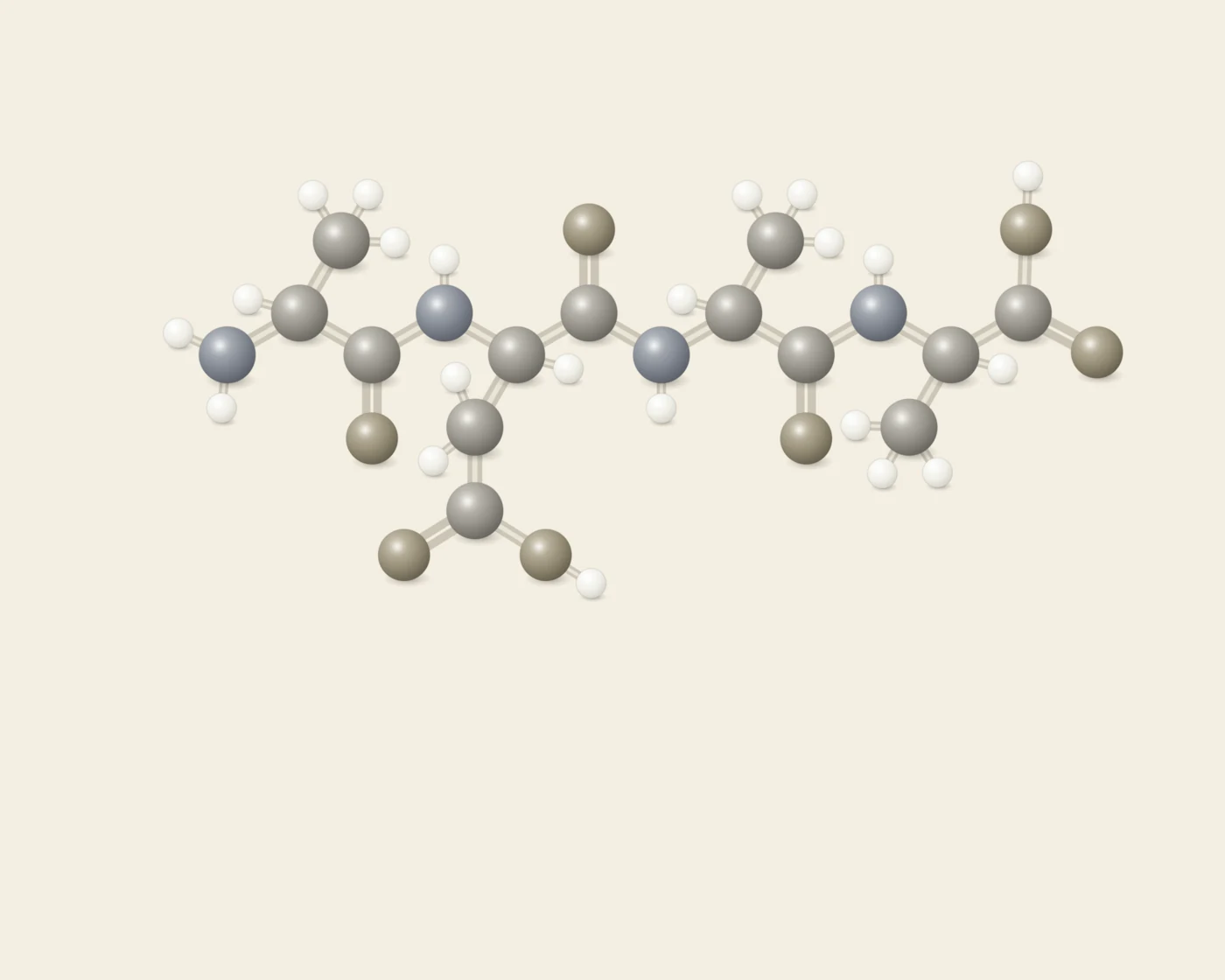
Sigumir is the extracted Cytomax capsule. Cartalax, also written Kartalax, is a synthetic short peptide: the tripeptide AED (Ala-Glu-Asp), made to a single defined formula.1
Nearly all the laboratory data vendors wave at Sigumir was generated with that synthetic peptide, not with the capsule. Lending the peptide's cell-culture history to the extract swaps one product for another, quietly, on the same page.
Capsules and lingual drops: the only two formats
Sigumir comes in two formats, both taken by mouth. The usual one is small capsules swallowed in short courses; the other is a lingual drop version, held under the tongue. It is not an injectable, and it does not come as a reconstituted powder the way the synthetic peptides do.
The drop regimen comes from retailer listings and the manufacturer's own labelling, not from a trial, so read any drop count printed on a listing as a seller's instruction rather than a tested schedule.
For an oral peptide preparation, the obvious question is how much of a tissue-derived peptide mixture survives digestion intact to do anything systemic. For Sigumir, that question has not been answered, because the absorption work has not been published.
02 / MechanismHow Sigumir is proposed to work
Two mechanisms are offered for Sigumir. One belongs to the capsule and stops at a hypothesis. The other is borrowed from a molecule that is not in it.
Tissue specificity: the capsule's own cartilage claim
The governing idea across the Cytomax range is tissue specificity: peptides drawn from a given organ are said to carry signalling information relevant to that same organ in the recipient. For Sigumir the target tissue is the musculoskeletal system, so cartilage peptides are meant to guide cartilage.1
It is a coherent hypothesis, and the review literature frames it as a route to peptide chondroprotection in osteoarthritis.1 A hypothesis is where it stops, though. No published work isolates the capsule's fraction and shows it doing this in cartilage cells.
The borrowed Cartalax (AED) mechanism
The more detailed mechanism you will read about is not really Sigumir's at all. It belongs to the synthetic tripeptide AED, which has been reported to enter cells, bind sites in the DNA minor groove, and shift the expression of ageing-related genes.2
In cultured cells AED changed markers of proliferation and senescence, and modulated genes including IGF1 and TERT.2,3 That is a real line of work. It is also work on a defined synthetic peptide in kidney, skin and stem-cell systems, which is not the extract in the capsule you would buy.
The mechanism section is where the swap happens most quietly. A vendor describes AED binding DNA and regulating genes, then prints it under a product that is a crude cartilage extract. The molecule that did the binding is not the molecule in the bottle.
What the Sigumir evidence actually shows
The studies below are grouped by what was actually put in the dish or the animal, which is the only way the borrowing becomes visible. Most of it is not the capsule.
With a single Italian collaboration aside, every study comes from the St Petersburg Institute of Bioregulation and Gerontology and the Pavlov Institute, the group around Khavinson that developed the range. No unconnected laboratory has replicated any of it.
Cell and in-vitro studies (mostly not Sigumir, mostly not cartilage)
In human bone-marrow mesenchymal stem cells aged in culture, the peptides AED, KED and KE modulated ageing-related genes: IGF1 expression was enhanced 3.5 to 5.6 fold, and TERT rose about eightfold in one ageing model.3 This is the synthetic peptide, in a generic ageing assay, not chondrogenesis.
In ageing skin fibroblasts, AED and related peptides suppressed MMP-9 and raised proliferation markers, and AED reduced caspase-dependent apoptosis.4 Relevant to connective tissue in the loosest sense, and again skin, not cartilage.
AED and EDL raised proliferation and lowered the senescence markers p16, p21 and p53 while increasing SIRT-6 in renal cell culture, with a proposed DNA-binding mechanism.2 This is a foundational AED paper, and it is a kidney study.
AED and EDL stimulated cell renewal and reduced apoptosis in kidney explants from young and old rats, but did less than a crude polypeptide complex.10 A second kidney study, and the complex that beat both peptides was isolated from kidney, not cartilage.
AED, in a compound with other peptides, promoted neuronal differentiation of human periodontal-ligament stem cells.5 This is the one non-Russian collaboration, run with a group in Italy, yet still co-authored by Khavinson and still nothing to do with cartilage.
Tellingly, when Khavinson's own group reviewed the peptides most promising for chondrogenic stem-cell differentiation, it named SK2.1, BMP, B2A, LPP, CFOGER and others, and did not list Sigumir or AED at all.6 The group's own cartilage-mechanism paper leaves both out.
Kidney, skin, stem cells, periodontal ligament. That is the tissue list behind a capsule sold for your knees, and in every one of those studies the compound tested was the synthetic tripeptide rather than the extract you would swallow.
Animal studies: rat osteoporosis and the osteoarthritis claim
In ovariectomised rats, a cartilaginous-tissue extract preparation showed an osteoprotective effect on bone mineral density, both preventing loss and partly correcting it, with higher efficacy than the peptide it was compared against.7 The preparation is described as a cartilage extract, not named Sigumir, so read it as the class, not the product.
A 2023 review states that Sigumir and the AED tripeptide showed high efficacy in animal models of osteoarthritis.1 That is a summary sentence in a review from the originating institute, not a primary study you can weigh, and no named, isolated Sigumir OA experiment surfaces behind it.
The animal evidence is a single relevant primary study of the extract class in a bone model, plus a review's assertion. It is a real data point in the extract's favour, and it is a long way from the joint-rebuilding claims on the sales pages.
Human studies of Sigumir (read the small print)
One PubMed-indexed human report puts Sigumir into patients, and it is an uncontrolled observational series in which the capsule was one part of a multi-part treatment.
In 62 older patients with temporomandibular-joint disorders, Sigumir was used inside a complex programme alongside dental prosthetics and drug therapy, and the authors reported faster pain relief and better jaw function.8 No control group, no blinding, and Sigumir's effect cannot be separated from the rest of the treatment.
A review of bioregulatory therapy in dentistry lists Sigumir among cartilaginous-tissue peptides used in older patients.9 This documents that clinicians use it. It is not efficacy data, and it does not add a controlled trial to the file.
The same 2023 review states Sigumir was given orally to older osteoarthritis patients with effect.1 As with the animal line, this is a review sentence, not a citable trial with a cohort, a design and endpoints you can inspect.
What remains unproven
There is no randomised, blinded, or even controlled human trial of Sigumir the capsule showing that it protects cartilage, rebuilds joints, or slows musculoskeletal ageing.
The richer evidence belongs to a synthetic tripeptide tested in kidney, skin and stem cells, none of it independently replicated, and Khavinson's own cartilage review leaves the whole story out. That does not make Sigumir a scam. It makes it a capsule whose evidence is largely other compounds' evidence, worn secondhand.
04 / Benefits by evidenceSigumir benefits: the claims, and what the evidence supports
Sixty-two people with painful jaw joints are the entire human record here. Everything else under joint comfort, bone density and cartilage regeneration is rats, cells or a synthetic peptide, and you buy all three as one capsule.
Most plausible, least proven cleanly. It has the only direct human signal, the 62-patient jaw-joint series, but that signal is confounded by concurrent treatment and has no control arm.8 Suggestive, not established.
Some animal support. A cartilage extract protected bone density in ovariectomised rats.7 That is a rodent osteoporosis model of the class, not a demonstrated outcome in a person taking Sigumir capsules.
Least supported for the capsule. The chondrocyte and matrix claims lean on cell work with a synthetic peptide, mostly in non-cartilage tissue, and the group's own chondrogenesis review omits it.2,6 Buying Sigumir "to regrow cartilage" is buying a hypothesis.
Rebuilt cartilage is what the packaging implies and what has nothing behind it. Sixty-two people with sore jaws, treated with three things at once, is the whole of the human record, and we would still call it the best thing here.
05 / Dosage and protocolSigumir dosage and protocol
No dose-finding study exists for Sigumir. The figures below are Cytomax tradition and vendor convention, set out so you can recognise them on a label, and not a recommendation to dose yourself.
The course of Sigumir capsules as sold
Sigumir is typically sold as one to two capsules a day, taken in a course of about a month, sometimes repeated once or twice a year. These numbers come from product labels and community practice, not from a trial that established them.
No dosing study sits behind them. A page calling this "the clinical dose" has converted a habit into a claim, and we would read that as a fair test of how much else on the page to believe.
Why the oral route is the open question
Sigumir is only an oral product, which sidesteps the sterility risks of injectables but raises a different one. A tissue-derived peptide mixture has to survive stomach acid and gut enzymes to reach the bloodstream intact.
No published pharmacokinetic work shows how much, if any, of the fraction is absorbed and reaches cartilage. If a protocol matters to you, understand that even the basic question of whether the capsule delivers anything systemically is unresolved.
06 / Safety and side effectsSigumir safety and side effects
The small reports that exist describe Sigumir and its relatives as well tolerated, with no serious adverse events noted.8,9 Both reports were written by clinicians looking for improvement, not for harm.
Why "no side effects reported" is thin
Neither was a safety study, and one of them embedded Sigumir inside a wider treatment programme, so its tolerability finding covers a course of dental work as much as a capsule.8 Nobody has followed a Sigumir user for a year and written down what happened.
The Sigumir risks that are actually likely
Sigumir is an animal-tissue extract, so what you are actually trusting is a manufacturer's sourcing and processing of bovine material. Identity and purity are not things you, or any lab you hire, can confirm from the outside.
Because it is a crude fraction and not a single molecule, you cannot verify it the way you could a defined peptide. What is in the capsule is whatever the manufacturer put there, and no independent lab has checked it for you.
Who should be cautious with Sigumir
Anyone pregnant or breastfeeding, since it is untested there; anyone with a reason to avoid bovine-tissue products; and anyone with a musculoskeletal condition who might otherwise delay a treatment that actually works.
One confounded 62-patient series is a thin basis for treating a joint. A doctor can image it and name what is actually wrong, which is the step no capsule substitutes for.
07 / SourcingWhere to buy Sigumir safely in the UK
Because Sigumir is an extract rather than a defined sequence, the purity checks you would run on a synthetic peptide have nothing to match against. Verification here means judging a manufacturer, not a molecule.
Why a certificate of analysis tells you less here
For a synthetic peptide you can demand a certificate of analysis showing identity and purity by HPLC and mass spectrometry against a known mass. For a crude cartilage fraction there is no single sequence or mass to match.
So a certificate can confirm a peptide content without ever proving the product is what it claims. You are trusting the maker's process more than any document, and we would weight it that way.
Do not pay for Cartalax data
Check what a listing is actually selling you the evidence for. If it leans on chondrocyte cell studies or DNA-binding mechanisms, that work is the synthetic AED peptide, and a Sigumir capsule is not the thing that was tested.2,6
Neither product is wrong to buy, but you should know which one is in your hand. Paying extract prices for the peptide's laboratory reputation is the exact swap we watch this category make.
08 / ComparisonSigumir vs Cartalax and the other Cytomax bioregulators
Sigumir is usually shelved beside Cartalax and marketed as its natural twin. They are not twins. Cartalax is the defined synthetic tripeptide AED that carries the cell-study data, while Sigumir is the crude cartilage-and-bone extract that carries the tissue-specificity story and almost none of the direct evidence.1,2
Within the extracted Cytomax range, Sigumir is the cartilage-and-bone entry, sitting alongside organ-specific siblings aimed at other tissues. We map how the extracted capsules and the synthetic peptides differ, and which has real evidence, on our types of bioregulator guide.
Frequently Asked Questions
What is the difference between Sigumir and Cartalax?
Sigumir is a crude cartilage-and-bone extract sold as a Cytomax capsule, while Cartalax, also written Kartalax, is the synthetic tripeptide AED (Ala-Glu-Asp). Most of the cell-culture data you will read attached to Sigumir was actually generated with the synthetic peptide, so the two are worth keeping firmly apart.
What is Sigumir made from?
Sigumir is a crude peptide complex extracted from the cartilage and bone tissue of young animals, given the Cytomax catalogue code A-4. That makes it an organ extract rather than a defined molecule, which is why it cannot be verified the way a synthetic peptide can. Bovine-tissue sourcing is the practical risk.
Is there any clinical study of Sigumir?
Only one PubMed-indexed human report puts Sigumir into patients: an uncontrolled series of 62 older people with jaw-joint disorders, where Sigumir was used inside a wider treatment. There is no randomised or controlled trial of the capsule on its own for joints, cartilage or ageing.
Does Sigumir regrow cartilage?
Not on any evidence about the capsule. The cartilage and chondrocyte claims lean on cell studies of the synthetic AED peptide, and mostly in non-cartilage tissues like kidney and skin. Khavinson's own 2023 review of cartilage-forming peptides does not even list Sigumir or AED.
How many Sigumir capsules a day is the usual course?
There is no validated dose. Vendors commonly sell it as one to two capsules a day in courses of about a month, repeated once or twice a year. That is product-label convention and Cytomax tradition, not a dose any published study established.
Is there any difference between Sigumir capsules and lingual drops?
None that anyone has measured, because nothing published compares the two. The drops are held under the tongue and the capsules are swallowed, which is the whole of the stated difference. Neither route has absorption data behind it.
Is Sigumir safe to take long term?
Nobody knows. The few small reports describe it as well tolerated, but they were short, none were safety studies, and none tracked anyone over years, so continued use is unstudied territory. Talk to a clinician before treating a joint problem with it.
Does a Sigumir certificate of analysis prove anything?
Not identity, no. You can usually get a certificate, but Sigumir is a crude peptide fraction with no single defined sequence or mass, so it can show a peptide content without proving what the product is. You end up trusting the manufacturer's process more than any document.
Is Sigumir approved or legal?
Sigumir is sold as a dietary supplement or parapharmaceutical, not an approved medicine, and it is not evaluated by the MHRA, FDA or EMA. No authority has assessed a batch, which also means there is no recall route if one goes wrong.
Where can I buy Sigumir in the UK?
Not from a UK pharmacy. It is not an approved medicine here and is not evaluated by the MHRA, so it is not dispensed; UK buyers order it from online sellers, at their own risk. Our where to buy page covers what to check first.
- Myakisheva SN, Linkova NS, Kozhevnikova EO, Ryzhak GA. Chondrocytes secretory phenotype associated with aging: role in the pathogenesis of osteoarthritis and prospects for peptide bioregulation. Adv Gerontol. 2023;36(3):313–323. PMID: 37782637.
- Khavinson VKh, Tarnovskaia SI, Lin'kova NS, et al. Tripeptides slow down aging process in renal cell culture. Adv Gerontol. 2014;27(4):651–656. PMID: 25946838.
- Ashapkin V, Khavinson V, Shilovsky G, Linkova N, Vanuyshin B. Gene expression in human mesenchymal stem cell aging cultures: modulation by short peptides. Mol Biol Rep. 2020;47(6):4323–4329. PMID: 32399807.
- Lin'kova NS, Drobintseva AO, Orlova OA, et al. Peptide regulation of skin fibroblast functions during their aging in vitro. Bull Exp Biol Med. 2016;161(1):175–178. PMID: 27259496.
- Caputi S, Trubiani O, Sinjari B, et al. Effect of short peptides on neuronal differentiation of stem cells. Int J Immunopathol Pharmacol. 2019;33:2058738419828613. PMID: 30791821.
- Linkova N, Khavinson V, Diatlova A, Myakisheva S, Ryzhak G. Peptide regulation of chondrogenic stem cell differentiation. Int J Mol Sci. 2023;24(9):8415. PMID: 37176122.
- Povorozniuk VV, Khavinson VKh, Makogonchuk AV, et al. Effect of peptide regulators on the structural and functional status of bone tissue in ageing rats. Adv Gerontol. 2007;20(2):134–137. PMID: 18306703.
- Iordanishvili AK, Samsonov VV, Soldatova LN, Polens AA, Ryzhak GA. Application of bioregulating therapy in complex treatment of temporomandibular joint diseases in people of elderly and senile age. Adv Gerontol. 2012;25(1):181–186. PMID: 22708467.
- Pinelis IS, Pinelis YI, Kuznik BI, Iordanishvili AK, Vasiliev MA. Age features of bioregulatory therapy of dental diseases. Adv Gerontol. 2020;33(1):137–152. PMID: 32362097.
- Chalisova NI, Lin'kova NS, Nichik TE, Ryzhak AP, et al. Peptide regulation of cells renewal processes in kidney tissue cultures from young and old animals. Bull Exp Biol Med. 2015;159(1):124–127. PMID: 26033601.