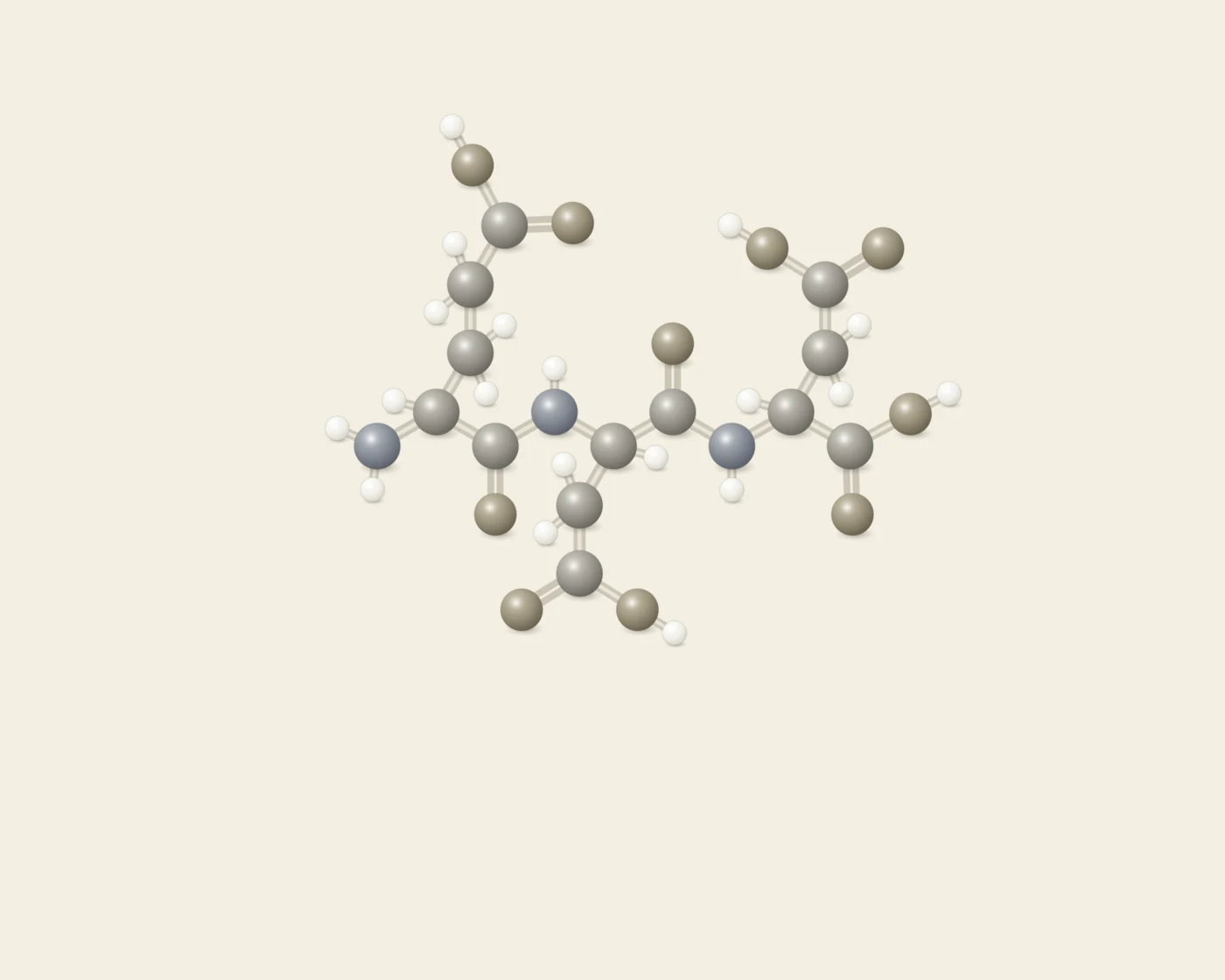
What Stamakort is: the A-10 gastric-mucosa extract
Stamakort is the oral, stomach-targeted entry in Professor Vladimir Khavinson's bioregulator range, carrying the Cytomax code A-10. It is a capsule of peptides extracted from the gastric mucosa of young cattle, sold to "restore" the ageing stomach lining. It is one of the thinnest-evidenced compounds in a range that already runs thin.
It is not a single defined molecule, and it is not synthetic. What you swallow is a crude, low-molecular-weight peptide fraction pulled from calf stomach tissue, closer to an organ extract than to a drug.
A crude extract has no sequence to check on a certificate, so nothing about the contents can be confirmed independently. You are trusting a process and a label rather than a molecule.
A-10 capsules are Cytomax, not injectable short-peptides
Stamakort belongs to the Cytomax line: oral extracts, taken as capsules or a sublingual version, in short courses. It is not an injectable, and it is not a synthetic tetrapeptide like Epitalon.
The tissue-extract technology behind these capsules is real, and Khavinson's group has published the general method it grew from.1 What the range does next is lend the reputation of a few well-studied members to every capsule on the shelf, and Stamakort is one that has almost nothing of its own.
What sellers claim Stamakort is used for
The pitch is that a gastric-mucosa peptide, taken by mouth, tells your stomach lining to repair and renew itself, easing gastritis and age-related digestive decline. Stomach complaints are common, people self-treat them readily, and some of the causes are serious.
Heartburn, bloating and a sore stomach are also how ulcers, infection and cancer present. We hold a capsule sold into that space to a higher standard than one sold for tired skin, and Stamakort does not come close to meeting it.
02 / MechanismHow Stamakort is proposed to work
The mechanism sold for Stamakort is the bioregulator hypothesis applied to the stomach. None of it has been measured in a stomach.
Gastric mucosa signalling: the headline claim
The idea is that short peptides extracted from an organ carry a signal specific to that organ, and feeding them back stimulates the tissue they came from. In Khavinson's early work, extracts encouraged the outgrowth of explants from their own source tissue and not others.1
That is a cell-culture and animal observation about the extract class, generated largely by one group. It is a reason to investigate a gastric peptide, and no measurement of what a capsule does inside a living human stomach.
The gene-expression claim, borrowed from pineal and retinal peptides
The deeper claim is that these peptides slip into cells and bind specific stretches of DNA, nudging which genes are transcribed, behaving a little like transcription factors.2,3 This is the mechanism the whole bioregulator range leans on.
The worked examples in those papers are pineal and retinal peptides. The DNA-binding sequences identified sit in the promoters of telomerase and retinal genes,2,3 nothing gastric. Stamakort inherits the mechanism by family membership, never by direct study.
Anyone telling you Stamakort "switches on" your stomach's repair genes is describing a hypothesis borrowed from work on other peptides, then presenting it to you as a demonstrated result. Those are not the same thing, and the distance between them is where your money is at risk.
What the evidence for Stamakort actually shows
PubMed indexes no human efficacy trial of Stamakort, and no study of the capsule under any other heading either.
What exists is experimental work on related peptides, plus one unindexed report on Stamakort itself, produced by the people who sell it.
Animal and in-vitro research behind the Stamakort claim
Khavinson's foundational review describes tissue-specific peptide preparations stimulating outgrowth of explants from their matching organ, and lists tetrapeptides designed for the heart, liver, brain cortex and pineal gland.1 A stomach peptide is not among the worked examples. This is class-level basis, not Stamakort data.
The group's experimental review summarises peptide bioregulators increasing lifespan and inhibiting carcinogenesis in laboratory animals.4 It is the broad evidence base the range trades on, produced largely within one institute, and it does not test the Stamakort capsule specifically.
The closest gastric datapoint in the literature: in rats under disrupted lighting, melatonin and epithalon restored age dynamics of pepsin activity in the stomach and pancreas, and little affected total proteolytic activity.5 Read the authors: the peptide tested was epithalon, the pineal compound, not Stamakort.
The animal signal that comes nearest to Stamakort's own organ was produced by epithalon, a pineal peptide. Every rung of the gastric capsule's evidence turns out to have been climbed by a better-studied cousin.
Human studies on Stamakort (read the small print)
One human report exists. It comes from the Medical Center of the St. Petersburg Institute of Bioregulation and Gerontology, the developer's own house, in patients with chronic gastritis.7
The report describes roughly 47 patients with chronic gastritis: about 30 given Stamakort alongside standard therapy, against 17 on standard therapy alone.7 It reported an easing of symptoms in the Stamakort group. We cannot check those figures against any database, because the study was never peer-reviewed or indexed in PubMed.
When Khavinson's team published its review of the bioregulators with real clinical study behind them, the list ran Timalin, Thymogen, Vilon, Epithalamin, Prostatilen, Cortexin and Retinalamin.6 Stamakort is not on it. The people who make it left it off their own evidence roll.
A manufacturer-run report with an add-on standard-therapy arm is an open evaluation rather than a controlled trial, and it did not survive into the developer's own clinical review.6,7
We weigh that omission above everything else on this compound. When the people with every commercial reason to count a result decline to count it, that is a verdict from the best-placed judges available.
What remains unproven
There is no randomised, blinded, independently run human trial showing that a Stamakort capsule repairs the gastric lining, eases gastritis, or slows any age-related change in your stomach.
There is no PubMed-indexed study of the product at all. Its mechanism is borrowed from work on other peptides, its animal support tests its cousins, and its one human report is unindexed and uncounted by its own makers.
04 / Benefits by evidenceStamakort benefits: the claims, and what the evidence supports
If a doctor has told you that you have gastritis or an ulcer, read the third row below before the other two. Comfort, repair and treatment of a disease escalate in boldness and descend in support, and the third is where people get hurt.
Weakly supported, at best. The only human report suggests eased gastritis symptoms, but it is unblinded, developer-run and unindexed.7 Any easing could be the standard therapy the group also received, or the natural course of a flare.
Unproven in humans. The tissue-repair idea rests on class-level extract work and animal models using other peptides.1,5 No study has shown that a Stamakort capsule rebuilds a human stomach lining. Treat "restores the mucosa" as a hope, not a finding.
Not a claim you should act on. Stamakort is a supplement, not a licensed treatment, and no trial supports using it against a diagnosed stomach condition. If you have gastritis or an ulcer, that is a matter for a doctor, not a capsule.
Renew your stomach, turn back the ageing gut: that is the order the marketing puts things in. The evidence puts them the other way up, and its top rung is one report the inventors left out of their own clinical summary.6
05 / Dosage and protocolStamakort dosage and protocol
No dose-finding trial for Stamakort has ever been run. The figures below are what appears on vendor packaging, reported so you can recognise a convention when you see one, and not a recommendation to dose yourself.
The daily dose and course length as sold
Vendors typically suggest one to two capsules daily for 10–30 days, repeated once or twice a year. That pattern is Cytomax-range tradition, copied across the oral bioregulators, not a schedule any published human study established for the stomach product.
Why the label dose is not a clinical dose
A dose earns the word "clinical" when a trial has tested it against an endpoint. For Stamakort no such trial exists, so the figure on the label is a habit dressed as a protocol.
A page presenting that course as "the proven Stamakort protocol" has converted a convention into a claim, and the word doing the work is one nobody earned.
Oral Stamakort absorption: the question nobody answers
Stamakort is a peptide preparation swallowed into a stomach full of acid and protease: the machinery whose whole job is to dismantle peptides. The target organ is also the obstacle.
How much survives intact is unestablished for these oral capsules. Vendor pages do not answer it because no published study could, and it is the question everything else depends on.
06 / Safety and side effectsStamakort safety and side effects
The little that exists reports Stamakort as well tolerated, with no serious adverse events noted. The source of that reassurance is a single unindexed report written by the manufacturer.
Why "no side effects reported" tells you little about Stamakort
That report was small, short, looking for benefit rather than harm, and never independently reviewed.7 Roughly 47 gastritis patients over a course of weeks is not a dataset that could detect an uncommon problem, or a slow one.
The real risk: the product and the delay
A crude animal-tissue extract sold as a supplement is not tested to medicine standards, and nothing in the capsule can be verified by you or anyone acting for you. That is the smaller of the two problems.
The sharper danger is time. If persistent stomach pain is met with Stamakort while its cause goes unexamined, a serious condition can be missed. Gastritis-like symptoms can mask ulcers, infection, or worse, and a capsule does not diagnose them.
Who should not use Stamakort
Anyone who is pregnant or breastfeeding, since it is untested there; anyone with ongoing or unexplained stomach symptoms, who needs a diagnosis first; and anyone hoping a supplement will substitute for investigating a real complaint.
A stomach complaint has a cause, and finding it takes an endoscope, a breath test or a biopsy. An unlicensed calf-tissue extract does none of those things, whatever it does to your symptoms.
07 / SourcingWhere to buy Stamakort safely in the UK
Because Stamakort is a crude extract rather than a defined molecule, the contents cannot be confirmed by sequence the way a synthetic peptide's can. Every check available to you stops at the packaging.
Nothing in the range is manufactured or licensed for sale in the UK. Buy from Britain and you are importing a Russian-made supplement, with the whole verification problem sitting on your side of the transaction.
What you can and cannot verify on a Stamakort capsule
What arrives is a capsule you are asked to take on faith, often on the strength of the Khavinson name rather than any test you can read. There is no mass to match, so a certificate can attest to a manufacturing process, not to a molecule you can independently check.
How to reduce the risk when buying from overseas
Prefer suppliers who trace back to the St. Petersburg manufacturer and publish batch and manufacturing documentation, ask what testing the capsule actually underwent, and treat a price far below the market as a warning to you, not a bargain. Ordering into the UK from overseas, that paper trail is the only real check you have.
What the money buys is a class reputation built by other peptides, attached to a product with no clinical evidence of its own. We would spend it on Thymalin or Cortexin before this one.
08 / ComparisonStamakort vs the better-studied bioregulators
Stamakort shares a shelf with bioregulators that carry genuine, if independently weak, clinical literature. Thymalin, Cortexin and Epithalamin all appear in Khavinson's own clinical review; Stamakort does not.6 On the range's own scorecard, you are looking at one of its emptier entries.
Suprefort, the pancreatic Cytomax sold alongside it, sits in the same tier: same extract technology, same absence from that clinical review.
The distinction you most need is oral extract versus injectable synthetic. Stamakort is a crude oral capsule with almost no data; the synthetic short-peptides are defined molecules you can at least verify. We map the whole family, and where each one's evidence really sits, on our types of bioregulators guide.
Frequently Asked Questions
Has Stamakort been tested in a human clinical trial?
No trial that would satisfy a sceptic. There is one report of roughly 47 gastritis patients from the developer's own institute, unblinded and never indexed in PubMed. It is not a randomised, blinded, independently run study, and the inventors left it out of their own clinical review.
Does Stamakort help with gastritis?
There is no reliable evidence that it does. It is a supplement, not a licensed medicine. Persistent stomach symptoms need a diagnosis from a doctor, because the cause can be serious and a capsule does not find it.
What is Stamakort made from?
It is a crude, low-molecular-weight peptide fraction extracted from the gastric mucosa of young cattle, carrying the Cytomax code A-10. It is not synthetic and not a single defined molecule, which puts it closer to an organ extract than to a drug.
Why is Stamakort not in Khavinson's clinical review?
Because it has no clinical study of the kind that review summarised. When Khavinson's group listed the bioregulators with real clinical evidence, they named Timalin, Thymogen, Vilon, Epithalamin, Prostatilen, Cortexin and Retinalamin. Stamakort's absence tells you where its evidence stands.
Is oral Stamakort absorbed, or destroyed by stomach acid?
Nobody has shown that it survives the journey intact. Stamakort is a peptide preparation swallowed into stomach acid and digestive enzymes, the very system that breaks peptides down. How much reaches the bloodstream in a usable form has not been measured for these capsules, and the vendor pages do not answer it.
What is the typical Stamakort dosage?
Vendors commonly suggest one to two capsules daily for 10–30 days, once or twice a year. That is Cytomax-range convention copied across the oral bioregulators, not a dose any published human study established for the stomach product. Treat it as tradition, not a clinical protocol.
Is Stamakort approved or licensed in the UK?
It holds no UK licence: it is sold as a dietary supplement or "parapharmaceutical", not a registered medicine. It is not approved by the MHRA, FDA or EMA, and it is not evaluated as a treatment. Supplement rules govern labelling and hygiene; nobody checks whether the product works.
How do I know a Stamakort capsule is genuine?
You largely cannot verify it by content, because a crude extract has no sequence to match. Prefer suppliers tracing to the St. Petersburg manufacturer with batch documentation, ask what testing was done, and be suspicious of prices far below the market.
Can you take Stamakort with other bioregulators?
Nobody has studied that combination, or any other. There is no PubMed-indexed study of Stamakort taken on its own, so there is certainly none testing it alongside a second bioregulator. Sellers bundle courses anyway, which shifts more boxes and proves nothing: no reported interaction is not the same as a demonstrated safe one.
What is the difference between Stamakort and Suprefort?
The organ they are extracted from. Stamakort is the oral Cytomax made from calf gastric mucosa, carrying the code A-10; Suprefort is the pancreatic one from the same range. Both are crude tissue extracts rather than defined molecules, and neither appears in Khavinson's own clinical review.
- Khavinson VKh. Peptides and Ageing. Neuro Endocrinol Lett. 2002;23 Suppl 3:11–144. PMID: 12374906.
- Khavinson V, Shataeva L, Chernova A. DNA double-helix binds regulatory peptides similarly to transcription factors. Neuro Endocrinol Lett. 2005;26(3):237–241. PMID: 15990728.
- Khavinson VKh, Shataeva LK, Chernova AA. Effect of regulatory peptides on gene transcription. Bull Exp Biol Med. 2003;136(3):288–290. PMID: 14666197.
- Khavinson VKh, Kuznik BI, Ryzhak GA. [Peptide bioregulators: the new class of geroprotectors. Communication 1. Results of experimental studies]. Adv Gerontol. 2012;25(4):696–708. PMID: 23734519.
- Morozov AV, Khizhkin EA, Svechkina EB, et al. Effects of Geroprotectors on Age-Related Changes in Proteolytic Digestive Enzyme Activities at Different Lighting Conditions. Bull Exp Biol Med. 2015;159(6):761–763. PMID: 26519279.
- Khavinson VKh, Kuznik BI, Ryzhak GA. [Peptide bioregulators: the new class of geroprotectors. Message 2. Clinical studies results]. Adv Gerontol. 2013;26(1):20–37. PMID: 24003726.
- Medical Center of the St. Petersburg Institute of Bioregulation and Gerontology. Evaluation of Stamakort in patients with chronic gastritis. Manufacturer report; not peer-reviewed and not indexed in PubMed (no PMID).