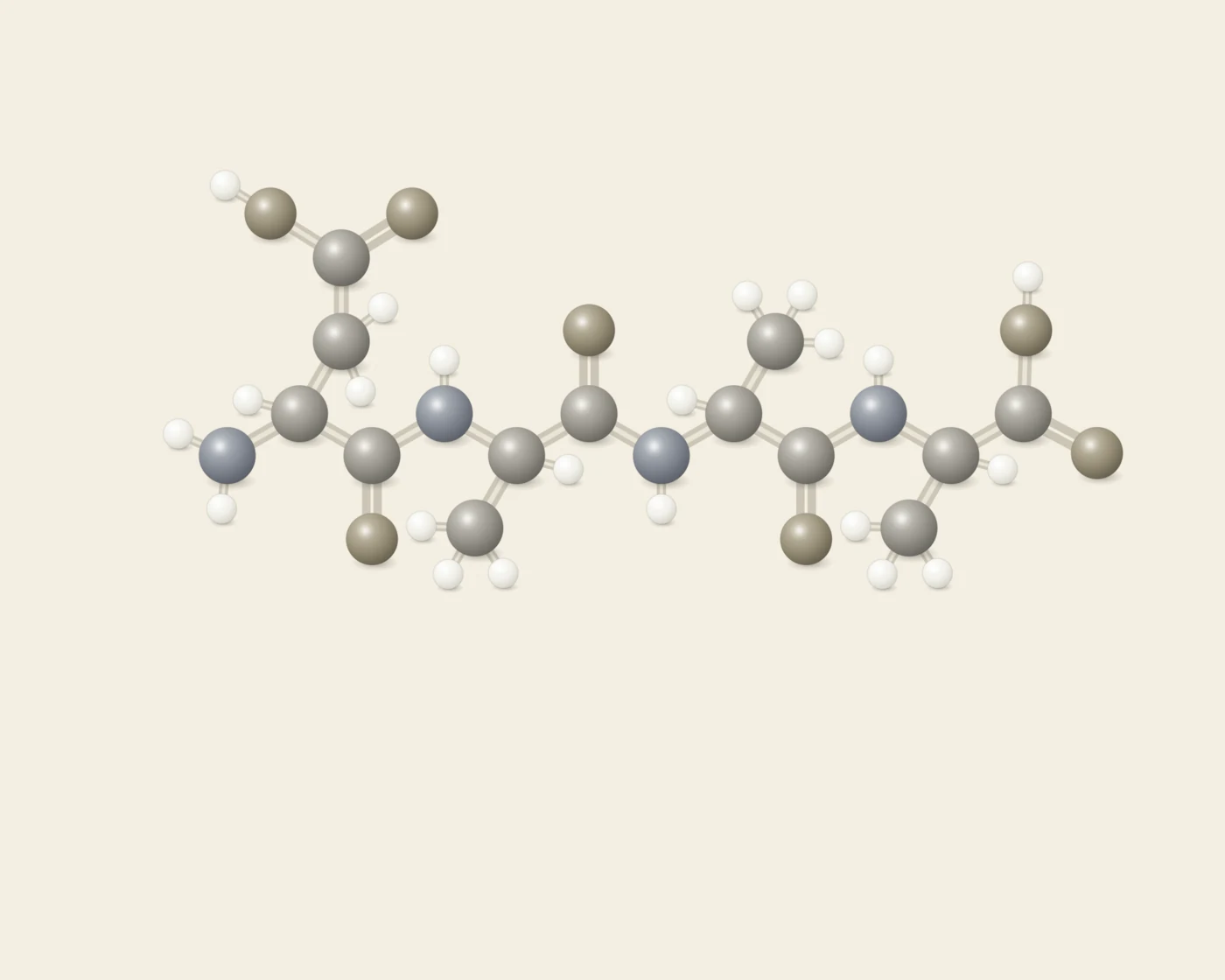
What Cerluten is
Cerluten is the oral brain-and-nervous-system entry in the Cytomax range: the line of natural peptide bioregulators that Vladimir Khavinson's St Petersburg group extracts from animal organs rather than synthesises. Its catalogue designation is A-5, and it is sold in capsules for cognition, "CNS restoration" and healthy brain ageing.
What you are actually buying is a crude preparation, not a defined drug. Cerluten is a water-soluble fraction of low-molecular-weight peptides, broadly under 10 kilodaltons, isolated from the cerebral cortex of young cattle. It is a mixture, not a single molecule, and that distinction shapes everything below.
The compound is real and the extraction technology is real. The evidence that swallowing a capsule of it does any of the things the sales pages promise is a different matter, and thinner than almost any buyer expects.
Not the same product as Cortexin
The credible clinical research on brain-derived Khavinson peptides belongs to Cortexin, a separate, injectable, cortex-derived medicine with a controlled stroke trial behind it. Cerluten borrows that reputation without owning the data, and almost every listing blurs the line.
The two come from similar tissue and share a family resemblance, so vendors lean hard on the overlap. If you are choosing between them expecting the same evidence, read our Cortexin vs Cerluten comparison and the Cortexin page before you spend anything.
Capsules and Cerluten Lingual, not injectable
Cerluten is sold in two closely related oral forms, both taken in short courses: small capsules you swallow, and Cerluten Lingual, the same cortical extract in a version you dissolve under the tongue. Neither is a lyophilised powder you reconstitute and inject, which is what Cortexin is.
Do not read the lingual form as an upgrade. It has no evidence of its own, and the case for holding the extract under your tongue is a vendor argument about absorption rather than the result of any comparison anyone has published.
Format is where the evidence splits. The injectable cortical drug is the one that went through trials; the oral capsule on the supplement site is the one that did not.
02 / MechanismHow Cerluten is proposed to work
The governing idea is the bioregulator hypothesis: peptides drawn from a specific organ are said to carry signalling information relevant to that same organ in the recipient. For Cerluten, the target tissue is the brain, so cortical peptides are meant to help cortical function. It is a coherent story on paper.
Nothing in that story has been measured for this specific capsule. The hypothesis covers a class of organ peptides; Cerluten is one uncharacterised cortical mixture inside it.
What a Cytomax extract actually is
A "Cytomax" preparation is not a clean drug. It is a crude polypeptide mixture, which is why batch-to-batch consistency is hard to guarantee and why no one can tell you the exact sequence of what you swallowed.
The one Khavinson organ complex that has been dissected in detail is the pineal preparation, not the cortical one. Mass spectrometry found it is mostly tripeptides, around 51 per cent, with dipeptides, tetrapeptides and only trace amounts of longer chains.3 The cortical fraction in Cerluten has had no comparable public breakdown.
The single-peptide attribution problem in Khavinson complexes
The institute's own work argues that the biological effect of a whole polypeptide complex is driven by one short peptide inside it.3 That is a strong claim to make about a crude extract, and it is the move that lets marketing attach a tidy mechanism to a messy mixture.
The hypothesis is not absurd. The leap the marketing makes is from "cortical peptides plausibly signal to cortical tissue" to "this capsule restores your brain." That is a leap across several unproven steps, and for Cerluten specifically not one of them has been measured in a person.
Whether swallowed Cerluten peptides survive digestion
Cerluten is swallowed, so its peptides face stomach acid and digestive enzymes before they could reach the brain. How much survives intact, crosses into the blood and then the blood-brain barrier, has never been established for this product.
03 / The evidenceWhat the evidence on Cerluten actually shows
PubMed returns nothing for Cerluten: no indexed trial, no cohort, no cell study under that name. For a capsule sold on brain benefits, that is the whole file.
What fills the gap on vendor pages is Cortexin's trial record, and that borrowed credibility is what you are actually being sold.
Evidence for the capsule itself
None. A search for "Cerluten" returns zero results in the PubMed database. There is no indexed human trial, animal study or cell study for the product under its own name.
The support vendors point to is a small, non-randomised, manufacturer-run report that was never peer-reviewed or PubMed-indexed. It is generated by the group that sells the product, with no placebo arm and no independent replication. As evidence for a brain benefit in you, it carries almost no weight.
We grade the direct evidence for oral Cerluten as thin even by this field's standards. Nothing controlled exists to point to.
The Cortexin evidence Cerluten borrows
The real data belongs to a different product. Cortexin is the injectable, registered cortical medicine, and it has been through controlled trials that Cerluten has not.
A multicentre, double-blind, placebo-controlled trial enrolled 272 patients with acute ischaemic stroke, giving Cortexin at 10 mg three times a day intramuscularly.1 This is a genuine controlled trial, and it is the credibility Cerluten quietly leans on. Note the format: injected, not swallowed.
A randomised comparison put Cortexin against another neuropeptide, Cellex, in 40 patients recovering from ischaemic stroke, with Cortexin at 10 mg intramuscularly daily for 10 days.2 Cellex came out ahead on the stroke and cognitive scores. Even Cortexin's own trial record is not uniformly strong.
The controlled data covers an injected drug given to stroke patients, not a capsule taken by a healthy person for "brain ageing". Related tissue, different product, route, dose and population.
What remains unproven
No randomised, blinded, independently run human trial shows that oral Cerluten improves cognition, restores the nervous system or slows brain ageing.
The closest real evidence is Cortexin's, and that is a different product in a different format for a different indication. When a listing lends you Cortexin's trial to sell you a Cerluten capsule, it is swapping one product for another and hoping you will not notice.
04 / Benefits by evidenceCerluten benefits: the claims, and what the evidence supports
What would count as evidence that a cortex capsule sharpens your memory? A trial in people swallowing that capsule. There is not one, and that absence runs through every claim below.
Unproven for Cerluten. The idea rides on Cortexin's stroke data, which used an injected drug in patients with brain injury, not an oral capsule in a healthy person. Buying Cerluten "for cognition" is buying a hypothesis, not a demonstrated outcome in you.
Least supported and most oversold. "Restoration" implies a measured recovery that no Cerluten study has shown. It is marketing language dressed as a mechanism.
A hypothesis, no more. Where the Khavinson institute does have human-ish data on ageing, it is for defined peptides and other tissues, such as a pineal peptide raising a melatonin metabolite about 1.7-fold.4 That is not Cerluten, and not the cortex.
The honest hierarchy is uncomfortable for a product page: every headline benefit is unproven for the thing in the bottle. The one real signal in this family belongs to the injectable next door, not the capsule in your hand.
05 / Dosage and protocolDosage and protocol for Cerluten
Nobody has run a dose-finding trial for Cerluten. The figures below describe what sellers put on a box, and we print them so you can recognise a convention when you see one, not so you can follow it.
The marketed capsule course and cycle length
The common pattern is 1 to 2 capsules daily for 10 to 30 days, repeated once or twice a year. These numbers come from vendor labels and Cytomax house convention, not from any published dose study of Cerluten. A page calling that "the clinical protocol" has promoted a house habit to a finding.
Oral capsules versus the injectable Cortexin dose
The controlled cortical data used Cortexin at 10 mg by intramuscular injection.1 Cerluten is a low-dose oral capsule, and no arithmetic carries a dose from one to the other.
The injected route is the one with trial data behind it. The swallowed capsule is the one the evidence has never touched.
06 / Safety and side effectsCerluten safety and side effects
Vendors describe Cerluten as well tolerated, and short courses of Cytomax capsules have not generated notable safety alarms. The record they are describing is an empty one, collected by nobody in particular.
Why "well tolerated" is not a Cerluten safety finding
There has been no safety trial of Cerluten. The reassurance rests on an absence of complaints about a capsule nobody has followed up, which is a statement about the state of the paperwork rather than about your risk.
The likelier risk: an unregulated animal-tissue extract
What is most likely to go wrong is the supply chain rather than the biology. Cerluten is a crude animal-tissue extract, sold as a supplement, with no medicines regulator checking identity, dose or contamination. What arrives is often a vial or blister with a Cyrillic label and no certificate of analysis.
Because it is an animal-derived extract rather than a defined synthetic, you also cannot verify it the way you could a single peptide sequence. You are trusting the maker on tissue source, purity and sterility, with no independent check available to you.
Who should be cautious with Cerluten
Anyone pregnant or breastfeeding, since it is untested there; anyone with a neurological condition who assumes a capsule can substitute for treatment; and anyone dosing without a clinician who knows their history.
An unpublished manufacturer report is the entire case for swallowing this. If cognitive symptoms are what brought you here, they belong in front of a GP who can investigate them, not in front of a supplement listing.
07 / SourcingWhere to buy Cerluten safely in the UK
Sourcing Cerluten is harder to police than sourcing a defined peptide. With a single synthetic sequence you can demand a certificate matching an exact mass. With a crude cortical extract there is no clean fingerprint to check against, so verification stops well short of proof.
What you can and cannot verify in a cortical extract
Ask for whatever documentation exists on tissue source, manufacturing and testing, and prefer a seller who tells you where the batch came from. Understand the ceiling: for an under-10-kDa animal extract there is no equivalent of the HPLC-and-mass-spec identity check you would run on a synthetic peptide. You buy on trust more than proof.
Do not pay for Cortexin's evidence
The costliest mistake in this market is a bait-and-switch of evidence rather than a fake capsule. A listing that sells you Cerluten while citing stroke trials, cortical neuroprotection or registered-drug status is describing Cortexin.
Cerluten is an oral supplement with almost no data of its own; Cortexin is an injectable medicine with a 272-patient trial. Know which one is in your hand before you pay.
08 / ComparisonCerluten versus Cortexin
Cerluten is almost always shelved beside Cortexin. Cortexin is the injectable, cortex-derived medicine carrying the controlled stroke data.1,2 Cerluten is the oral Cytomax capsule with no indexed study of its own.
Same broad tissue origin, entirely different evidence. One went through a double-blind trial in 272 patients; the other rests on an unpublished manufacturer report. We treat them as different products with a shared adjective.
We set the two side by side in full on our Cortexin vs Cerluten guide, and you can see where each fits in the wider range on our peptide bioregulator types page.
Common questions about Cerluten
The answers below stop where the measurements stop. Several of them are "nobody has looked", and we would rather print that than fill the space with sales copy.
Is there clinical evidence that Cerluten works?
No. A PubMed search for Cerluten returns nothing: no human trial, no animal study, no cell study under that name. The only support is a small, non-randomised, manufacturer-run report that was never peer-reviewed.
Cerluten vs Cortexin: are they the same product?
No, and this is the mistake that costs buyers most. Cortexin is an injectable, registered cortical medicine with a controlled stroke trial. Cerluten is an oral supplement capsule with no indexed study of its own. They come from related tissue but are different products with very different evidence.
What is Cerluten made from?
A crude, water-soluble fraction of low-molecular-weight peptides, broadly under 10 kilodaltons, extracted from the cerebral cortex of young cattle. It is a mixture rather than a single defined molecule, which is why it is hard to verify and hard to standardise between batches.
What is Cerluten Lingual and how is it different from the capsules?
Cerluten Lingual is the sublingual version of the same cortical extract, dissolved under the tongue rather than swallowed. The case for it is a vendor argument about absorption, and no published comparison of the two forms exists. Treat it as a format choice, not a stronger product.
How many capsules of Cerluten do you take per day?
Vendors commonly suggest 1 to 2 capsules daily for 10 to 30 days, once or twice a year. There is no validated human dose behind those figures: they are Cytomax-range convention, not the output of any published dose study of Cerluten.
Does Cerluten reach the brain when you swallow it?
Unknown. As an oral peptide preparation it faces digestion in the gut, and how much survives intact to cross into the blood and then the brain has not been established for this product. That gap sits under every benefit claim made for it.
Is Cerluten approved by the MHRA or FDA?
No. Cerluten is sold as a dietary supplement or "parapharmaceutical", not a registered medicine, and it is not approved by the FDA, EMA or MHRA. No medicines regulator has assessed it for efficacy, so its evidence has never had to clear a regulatory bar.
Where can you buy Cerluten in the UK?
There is no UK pharmacy route, because Cerluten is not a registered medicine here, so a UK buyer is importing a supplement from an overseas vendor.
Know the ceiling on what you can check: a crude cortical extract has no identity test equivalent to the one you would run on a synthetic peptide. Ask for whatever tissue-source and batch documentation exists, and see our where to buy page.
Does Cerluten improve cognition or memory?
On current evidence there is no controlled data showing an oral Cerluten capsule improves cognition or memory in a healthy person. The cognition case borrows Cortexin's injectable stroke data, which is a different product, route and population. Treat the benefit as a hypothesis, not a result.
What is the difference between Cerluten and Cerebramin or Pinealon?
Cerluten and Cerebramin are both oral Cytomax preparations, crude peptide extracts of brain tissue. Pinealon is different in kind: a short, defined synthetic peptide rather than an extract. None of the three carries the controlled human data Cortexin has, and you can see where each sits in our peptide bioregulator types guide.
- Aliferova VM, Dadasheva MN, Doronin BM, et al. [Clinical efficacy and pharmacoeconomic characteristics of the neuroprotection with low doses of cortexin in the treatment of acute ischemic stroke]. Zh Nevrol Psikhiatr Im S S Korsakova. 2014;114(4):41–46. PMID: 24874316.
- Khabirov FA, Khaibullin TI, Granatov EV, et al. [Comparison of the efficacy of Cellex and Cortexin in patients in the early recovery period of ischemic stroke]. Zh Nevrol Psikhiatr Im S S Korsakova. 2020;120(12 Vyp 2):11–15. PMID: 33449527.
- Khavinson VK, Kopylov AT, Vaskovsky BV, Ryzhak GA, Lin'kova NS. Identification of Peptide AEDG in the Polypeptide Complex of the Pineal Gland. Bull Exp Biol Med. 2017;164(1):41–43. PMID: 29124531.
- Ivko OM, Linkova NS, Ilina AR, Sharova AA, Ryzhak GA. [AEDG peptide regulates human circadian rhythms genes expression during pineal gland accelerated aging]. Adv Gerontol. 2020;33(3):429–435. PMID: 33280326.