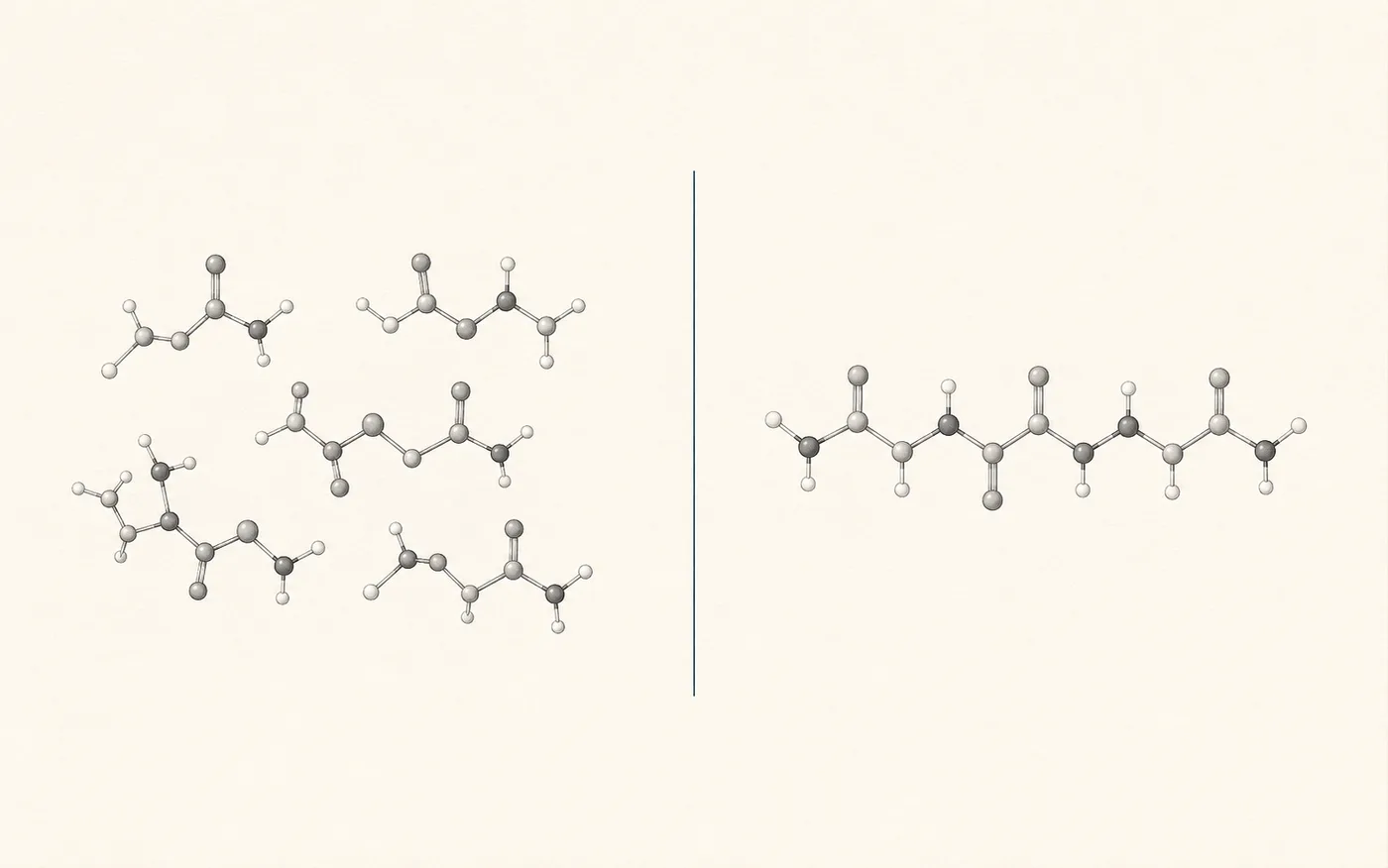
At a glance
| Cortexin | Cerluten | |
|---|---|---|
| Class | Cortical polypeptide, cerebral-cortex derived | Cytomax peptide bioregulator, CNS-targeted (A-5) |
| Format | Injectable only, reconstituted powder, intramuscular | Oral only, capsule (and sublingual “lingual”) |
| Regulatory status | Registered prescription medicine in Russia / CIS; not FDA/EMA/MHRA approved | Sold as a supplement; not FDA/EMA/MHRA approved |
| Best human evidence | Placebo-controlled stroke RCT, n=272 (Aliferova 2014) | None PubMed-indexed, one unblinded manufacturer report |
| Evidence grade | High volume, low independent quality | Very thin, no indexed human trial |
| Protocol as used | 10 mg IM once daily for 10 days | 1–2 capsules daily for 10–30 days |
| Practical risk | Sterile technique, injection, animal-derived | Low procedural risk; efficacy unproven |
| Last reviewed | , | 19 July 2026 |
Cortexin and Cerluten get talked about as if they were two versions of the same thing, the injectable one and the capsule one. They are not. They share a tissue origin and a family resemblance, and vendors lean hard on that resemblance, but they sit at very different evidence levels.
Getting the distinction right is the whole point of this comparison, because it is the single most common mistake buyers make in this corner of the market.
If you are choosing between them for cognition, recovery, or “brain ageing”, the decision is not really about which peptide is stronger. It is about how much evidence you need before you act, and whether you will inject a prescription medicine or swallow a supplement. We’ll put the verdict up top, then show our working.
Cortexin vs Cerluten: The Short Answer
Cortexin is the one with actual clinical evidence behind it, and Cerluten is not. Cortexin is an injectable, cortex-derived compound that carries a Russian marketing authorisation and has at least one sizeable, double-blind, placebo-controlled stroke trial to its name (Aliferova et al., 2014, n=272).
Cerluten is an oral capsule sold as a supplement, and there is no PubMed-indexed human trial for it at all, its single supporting study is a small, unblinded report from the manufacturer’s own centre that was never peer-reviewed.
So if your decision rests on evidence quality, Cortexin wins, and it is not close.
The honest complication is that Cortexin’s edge comes at the cost of being an injectable prescription drug with all the sterility, sourcing, and legality friction that implies, while Cerluten’s one genuine advantage is that a low-dose oral capsule carries negligible procedural risk. You are trading evidence against convenience.
Neither has robust support for the everyday cognitive-enhancement use most buyers actually have in mind.
What Cortexin Is Best For
Cortexin is the better choice when you want the format with the stronger data and are prepared for an injectable. Its clinical literature, weak by Western standards, but real, clusters in acute neurological injury: ischaemic stroke recovery, traumatic brain injury, and the encephalopathies, plus supervised paediatric neurodevelopment use in Russia.
The Aliferova stroke trial is the anchor: a genuine randomised, placebo-controlled study, and about as good as the human evidence for either compound gets.
What Cortexin is not good for is the “add it to my morning stack” use case. It ships as a lyophilised powder that must be reconstituted and injected intramuscularly, which makes it a sterile-technique, supervised-medicine format rather than a supplement.
And there is no robust independent evidence for cognitive enhancement in healthy adults, that popular use extrapolates well beyond where the data goes. Choose Cortexin because you value the evidence and the registered-drug manufacturing, not because it is easy.
What Cerluten Is Best For
Cerluten is the better choice on exactly one axis: low procedural risk in an oral format. It is a small capsule (or a sublingual “lingual” version) taken in short courses, with negligible sterility or injection risk.
If you are set on an oral CNS bioregulator, are risk-averse about injectables, a profile that fits a lot of readers, and you accept going in that the efficacy evidence is essentially absent, Cerluten is that product.
Be clear-eyed about the trade. Cerluten’s marketed benefits, CNS “restoration”, memory and cognitive support, healthy brain ageing, have no human trial behind them; the strongest of those claims rests solely on an unblinded manufacturer report, and the rest borrow credibility from Cortexin’s stronger data and from animal work on related peptides.
It is also a crude polypeptide extract rather than a defined molecule, so per-capsule active content is not something a buyer can verify from the label. Cerluten suits the reader who wants a gentle oral option and has decided that convenience outweighs proof, with eyes open.
Cortexin vs Cerluten on Evidence Strength
This is where the two genuinely diverge, so we’ll be blunt. Both sit inside a literature dominated by Russian-language, manufacturer-adjacent studies with limited independent Western replication, but they are not at the same level within it.
Cortexin has a real randomised trial: the multicentre, double-blind, placebo-controlled study in 272 acute-ischaemic-stroke patients (Aliferova et al., 2014) reported better outcomes when 10 mg was given intramuscularly alongside standard care.
That is weak evidence that has not been stress-tested the way an approved Western drug’s has, independent reviewers still treat this class as low-certainty, but it is a placebo-controlled human trial, which is more than most bioregulators can show.
Cerluten has nothing comparable in the indexed literature. The one human study routinely cited for it is an open-label evaluation at the manufacturer’s own institute (48 patients versus 37 controls, 2003–2004): non-randomised, unblinded, developer-run, and never peer-reviewed or PubMed-indexed.
Tellingly, when Khavinson’s own team published its list of bioregulators with genuine clinical study behind them, Cortexin was on it and Cerluten was not. We read that omission as the honest headline.
If Researcher Dan is checking your sources, this is the line that matters: one decent stroke trial for Cortexin, versus a manufacturer report for Cerluten.
Cortexin vs Cerluten on Format and Dosing
The format gap is as large as the evidence gap, and the two are linked. Cortexin is injectable: a lyophilised powder reconstituted immediately before use (with saline, water for injection, or a procaine solution) and given intramuscularly.
The course reported in the literature is typically 10 mg once daily for 10 days in adults; the stroke trial used a more intensive schedule of two ten-day courses. That reconstitution-and-injection step is exactly why the “stack it” framing misleads: this is a sterile-technique medicine.
Cerluten is oral: one to two capsules daily for 10 to 30 days, repeated once or twice a year, with a standard 20-capsule pack built around a ten-day course.
But that number is a vendor and Cytomax-tradition figure, not the output of a human dose-finding study, none has been run, and because Cerluten is a crude extract, the actual quantity of any active peptide per capsule can’t be verified from the label.
So Cerluten is easier and lower-risk to take, while Cortexin’s dosing, for all its friction, at least traces to studied clinical use. Easier to take is not the same as better characterised.
Which Should You Choose?
Take the decision by scenario rather than by which peptide is “best” in the abstract.
If you want the strongest available evidence and are prepared for an injectable prescription medicine, the honest read points to Cortexin. It has the registered-drug status, the placebo-controlled stroke trial, and the more consistent animal data. Read our full Cortexin guide before deciding.
If you specifically want a low-risk oral product and accept that the efficacy evidence is essentially absent, Cerluten is that, a gentle capsule with negligible procedural risk and very little proof. Go in knowing you are buying convenience, not a demonstrated benefit. See the full Cerluten guide.
If your real goal is cognitive enhancement in a healthy adult, neither has robust evidence for it: you would be extrapolating well past the data in both cases, further with Cerluten than with Cortexin.
If you want the oral route but prefer a defined, synthetic peptide to a crude extract, look at Pinealon instead, with the same thin-evidence caveat. See our Pinealon guide.
Whichever way you lean, both are unlicensed or foreign-registered products with no meaningful long-term human safety data for self-directed use, and both are animal-derived. This is an education-first comparison, not a recommendation to obtain or self-administer either.
Frequently Asked Questions
What is the main difference between Cortexin and Cerluten?
Cortexin is an injectable, cortex-derived compound that is a registered prescription medicine in Russia and has a placebo-controlled stroke trial behind it.
Cerluten is an oral supplement capsule made from a crude cortical-peptide extract, with no PubMed-indexed human trial. They share a tissue origin and a family name, but not their format or their evidence base.
Is Cortexin or Cerluten better for cognition?
Neither has robust independent evidence for cognitive enhancement in healthy adults. Cortexin’s clinical studies concern stroke, brain injury, and paediatric neurology; Cerluten’s only human study is a small, non-randomised manufacturer report. Both popular cognitive uses are extrapolations beyond the data, more so for Cerluten.
Can I take Cerluten instead of Cortexin to avoid injections?
You can take Cerluten orally and avoid injections, and its low procedural risk is its one genuine advantage. But you would be trading away the stronger evidence: Cortexin has a placebo-controlled trial, Cerluten does not. Avoiding the needle does not make the capsule work.
Are Cortexin and Cerluten the same product in different forms?
No. This is the most common misconception. They come from similar tissue and share a family resemblance, but they are separate products, different format (injectable vs oral), different regulatory status (registered medicine vs supplement), and very different amounts of clinical data.
Are either Cortexin or Cerluten approved in the UK or US?
No. Cortexin is a registered medicine in Russia and some CIS countries but is not approved by the MHRA, FDA, or EMA. Cerluten is sold as a supplement and has not been assessed by any of those regulators. Using either outside its approved market is unregulated and at your own risk.
Author: Bioregulator Peptides Editorial Team
Last reviewed: 19 July 2026
References
- Aliferova VM, Dadasheva MN, Doronin BM, Kovalenko AV, Lokshtanova TM, Martynov MIu, Meshkova KS, Salimov KA, Stakhovskaia LV, Chefranova ZhIu, Shamalov NA. Clinical efficacy and pharmacoeconomic characteristics of the neuroprotection with low doses of cortexin in the treatment of acute ischemic stroke. Zh Nevrol Psikhiatr Im S S Korsakova. 2014;114(4):41–46. PMID: 24874316. https://pubmed.ncbi.nlm.nih.gov/24874316/ (Multicentre, double-blind, placebo-controlled; n=272, the credible human evidence, for the injectable Cortexin.)
- Khavinson VKh, Kuznik BI, Ryzhak GA. Peptide bioregulators: the new class of geroprotectors. Message 2. Clinical studies results. Advances in Gerontology (Uspekhi Gerontologii). 2013;26(1):20–37. PMID: 24003726. https://pubmed.ncbi.nlm.nih.gov/24003726/ (Author’s own review of clinically studied bioregulators; Cortexin is listed, Cerluten is not.)
- Report on the results of a clinical study of the peptide bioregulator Cerluten. St. Petersburg Institute of Bioregulation and Gerontology (open-label, non-randomised, n=48 vs 37 controls, 2003–2004). Manufacturer-associated report; not peer-reviewed and not indexed in PubMed. https://www.antiaging-systems.com/articles/report-on-the-results-of-clinical-study-of-peptide-bioregulator-cerluten/
A PubMed search for “Cerluten” returned no indexed clinical trials at the time of writing. Cortexin dosing reflects the Geropharm prescribing information; Cerluten dosing reflects vendor and Cytomax-tradition protocols, not a validated human dose. Verify against current labels and the buyer’s jurisdiction before relying on any figure.
Medical disclaimer. This article is for education and research information only. It is not medical advice, and nothing here is a recommendation to obtain, dose, or self-administer Cortexin, Cerluten, or any peptide. Cortexin is a prescription medicine in the jurisdictions where it is approved and is unregulated elsewhere; Cerluten is not an approved medicine and is unregulated in most jurisdictions. Consult a qualified medical professional before making any health decision. Statements about benefits reflect the current research literature, including its limitations, and have not been evaluated by the FDA, MHRA, or EMA.