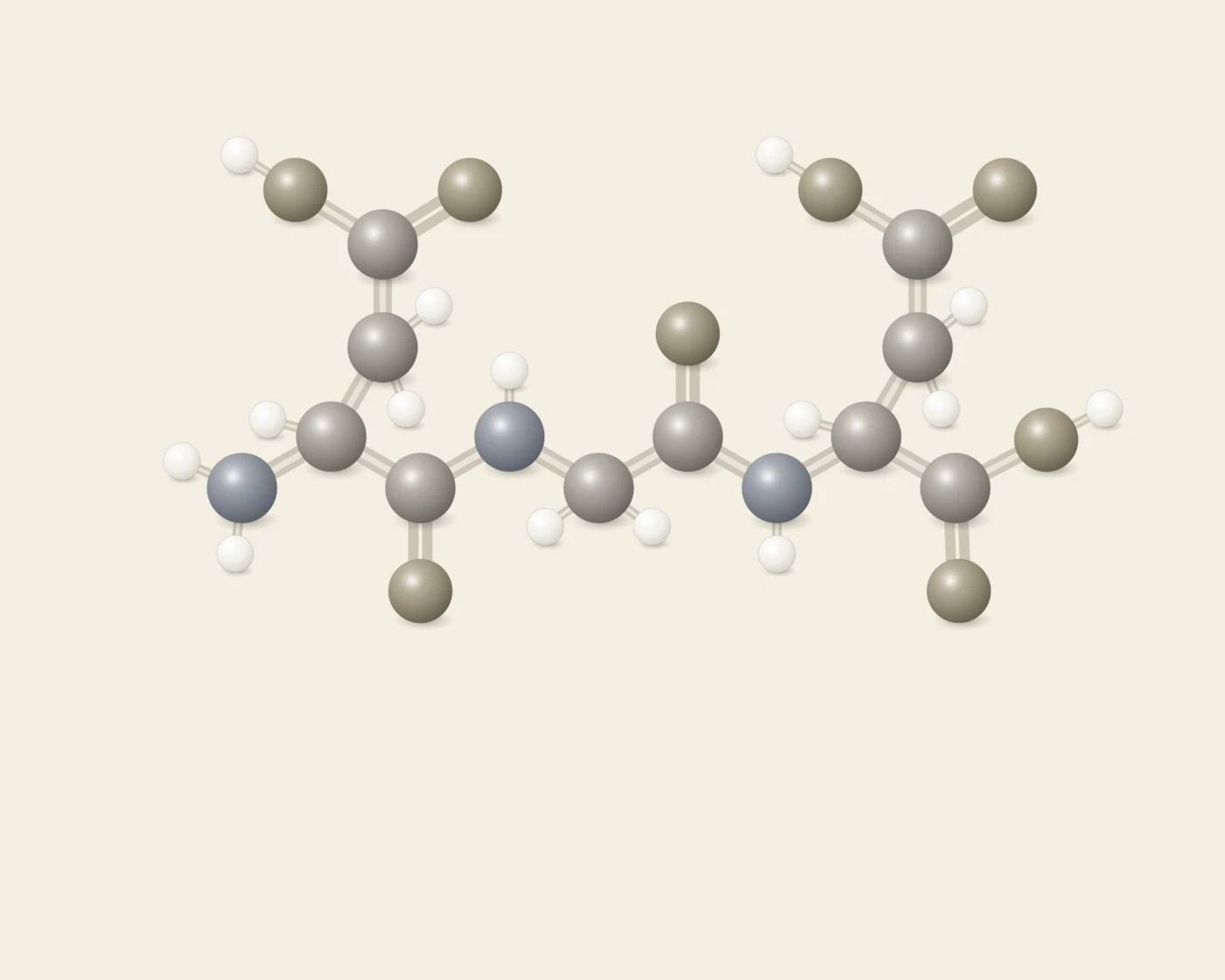
What Prostamax peptide is
Prostamax is the prostate-directed member of the Khavinson short-peptide family. In the published literature it is a synthetic oligopeptide, Lys-Glu-Asp-Pro: four amino acids (lysine-glutamate-aspartate-proline), abbreviated KEDP.
It is built to a single defined formula in a lab, not extracted from an animal gland. That matters to you before anything else: a defined molecule is cheap to make, consistent batch to batch, and easy to study in a dish.
It is sold to men worried about ageing prostate and urinary function: night waking, a weaker stream, the tests their GP has started ordering. That is a receptive audience, and the pitch is built for it.
The Prostatilen name trap
Prostamax and Prostatilen are different products. Prostamax is the synthetic oral tetrapeptide KEDP. Prostatilen is an injectable peptide preparation extracted from bovine prostate.
The two get blurred constantly, including on vendor pages. Prostatilen carries its own body of prostate work in the Russian literature.9,10 Prostamax does not, and lending one product's history to the other is the central sleight of hand here.
Most questions about "Prostamax clinical trials" turn out to be questions about Prostatilen. We treat that confusion as the single most expensive mistake a buyer makes on this compound.
Oral Prostamax capsules, not injections
You will meet Prostamax two ways: as capsules in the retail Cytomax-style range, and as a lyophilised powder in research-grade vials. Both are meant to be taken orally.
That is the opposite of Prostatilen, which is injected. If a listing offers you an injectable "Prostamax", that alone tells you the seller is either confused or selling you a different compound.
02 / MechanismHow Prostamax is proposed to work
The mechanism claimed for Prostamax is the general bioregulator hypothesis, pointed at prostate tissue. Part of it has been measured. The rest is inference.
KEDP, DNA binding and chromatin decondensation
The core idea is that these short peptides enter the cell, bind specific spots in the DNA double helix, and loosen tightly packed chromatin so that age-silenced genes can be read again.
There is real biophysics behind the binding step. In a DNA-melting study, short peptides including KEDP altered the melting temperature and stability of double-stranded DNA, with acidic and basic residues pulling in opposite directions.6
That is a measurement in a cuvette: purified DNA, a peptide, and a melting curve. It says nothing about whether swallowing KEDP shifts gene expression in your prostate.
Khavinson's "epigenetic regulator" framing
Khavinson's group frames these peptides as epigenetic regulators, short sequences that happen to match motifs in the genome. One bioinformatic paper reported such sequences appear in proteins of long-lived rodents and are absent in some short-lived species.8
Read that as a hypothesis-generating pattern, not as evidence that KEDP does anything in a person. It tells you where the idea comes from, not that it works.
Getting oral KEDP into the cell
For an oral peptide the obvious problem is the gut: how does a four-amino-acid chain survive digestion and reach a cell intact? A 2023 modelling study proposed that KEDP and similar peptides could ride into cells on the LAT and PEPT amino-acid transporters.7
That is a docking simulation, done in silico, not a measurement of how much Prostamax reaches your bloodstream. Oral bioavailability for this peptide has not been established in humans.
In cells and in models the mechanism is internally coherent. What no study shows is the step the marketing sells you: that an oral capsule of KEDP reaches the prostate, changes gene expression there, and improves a symptom you can feel.
What the Prostamax evidence actually shows
The Prostamax file runs to a handful of chromatin experiments on white blood cells and one culture study on rat prostate tissue. The marketing implies rather more.
No human efficacy trial of Prostamax exists for any prostate or urinary outcome. Everything below sits upstream of that.
Prostamax in cell and ex-vivo chromatin studies
Khavinson, Lezhava and Malinin tested several short peptides, Prostamax among them, on leukocytes from people aged 75 to 88. Prostamax activated ribosome genes and decondensed chromosome 1 pericentromeric chromatin.1 Originating-group work, ex-vivo cells.
A Georgian group reported that KEDP raised sister-chromatid exchanges from 5.9 to 12.0 per cell, and silver-positive nucleolar regions from 0.95 to 2.5 per cell, in cells from donors aged 75 to 86.2 A concrete effect on chromatin structure, in a dish.
Measuring chromatin melting directly, prostamax shifted two denaturation endotherms of human lymphocytes downward by about 2.9 and 1.0 degrees, read as a slight loosening of chromatin packing.3 In-situ biophysics.
A follow-up microcalorimetry study examined prostamax alongside copper and cadmium ions on lymphocyte chromatin from ageing donors.4 Mechanistic, and tangential to any prostate claim.
Four studies, three groups, one consistent in-vitro signal: KEDP loosens densely packed chromatin in old cells. Every one of them measured white blood cells, and none measured a prostate or a living person.
Prostate explants: the closest thing to animal data
In organotypic culture, synthetic peptides including prostamax stimulated tissue explants at a concentration of 0.05 ng/ml, with prostamax acting on prostate explants from young and aged rats.5 The closest thing to a prostate-specific result, and it is cultured tissue, not a treated animal.
We rate that explant study the most relevant thing in the file, because it is the only one that put Prostamax anywhere near prostate tissue. It is also cultured rat tissue, a long way from a man taking a capsule.
Human studies on Prostamax
The indexed literature holds no human efficacy trial of Prostamax, or KEDP, for prostatitis, benign prostatic hyperplasia, urinary symptoms or any other prostate endpoint.
The chromatin studies did use human cells, drawn from donors in their seventies and eighties, but a leukocyte in a dish is not a treated patient. No dose, no symptom score, no placebo arm, no follow-up.
Why the clinical trial evidence belongs to Prostatilen
When a page cites clinical benefit for a prostate peptide, trace the citation. It almost always lands on Prostatilen, the injectable bovine-prostate extract, or on Khavinson's general reviews of tissue-extract preparations.10,11
In an animal model of prostatic hyperplasia, Prostatilen at 1 mg of total peptides per kilogram limited the rise in prostate mass and volume.9 That is a result for Prostatilen, a different product, and it is not evidence for the synthetic KEDP capsule in your hand.
04 / Benefits by evidenceProstamax benefits: the claims, and what the evidence supports
Nobody buys Prostamax to loosen the chromatin in an ageing white blood cell. That is the only thing anyone has measured. The claims below run in the reverse order to the money.
Best supported, and still only in-vitro. Several overlapping groups report KEDP loosens chromatin in old human cells.1,2,3 It is a laboratory finding, not a health outcome.
Weakly supported. One explant-culture study shows an effect on prostate tissue.5 No living animal, no human, no symptom measured.
Unsupported by any trial. This is the reason most people buy Prostamax, and it is exactly the claim with zero human data behind it.
Symptom relief is the reason anyone parts with money for Prostamax, and it has nothing behind it. Chromatin packing in a leukocyte has the evidence, and nobody is buying that.
05 / Dosage and protocolProstamax dosage and protocol
No clinical trial has ever set a dose for Prostamax. What follows is what vendors put on the label, reported so you can recognise it, and it is not a recommendation to dose yourself.
Typical vendor dose and course length
Retail capsules are commonly taken as one to two per day for a 10 to 30 day course, repeated a few times a year. Those numbers come from product labels and community habit, not from a dose-finding study.
The studies that exist used nanogram-per-millilitre concentrations applied directly to cells,5 a unit that has no conversion into milligrams swallowed. The capsule dose was never derived from the research.
Oral dosing versus injectable Prostatilen
Prostamax is oral. The prostate peptide with an actual dosing history in patients is Prostatilen, which is injected, and its protocols do not transfer to a KEDP capsule.
If a protocol matters to you, be clear which product it belongs to. Borrowing Prostatilen's injection schedule for an oral KEDP capsule is mixing up two different compounds.
06 / Safety and side effectsProstamax safety and side effects
Prostamax has barely been studied for harm. Any reassurance you read about its safety rests on experiments that were not designed to detect it.
Why "no reported side effects" is not a safety record
The chromatin studies were not safety trials. They were small, short, and looking for a cellular effect, not tracking adverse events in dosed people over time.1,2,3
A compound with no human efficacy trial has no human safety dataset either. Nobody has dosed men with KEDP and counted what went wrong, so there is nothing to report and no reassurance in the silence.
The KEDP mechanism risk nobody has studied
The proposed mechanism is decondensing chromatin and switching silenced genes back on. In old cells that is pitched as rejuvenation, but derepressing genes is not automatically benign.
The same work reports increased sister-chromatid exchanges,2 a marker of genomic activity you do not obviously want more of in prostate tissue. Nobody has studied what chronic dosing does, and we would treat that unknown seriously.
The real risk is the product, not the peptide
Four amino acids are unlikely to do you damage. The capsule they arrive in is a different question: an unregulated product can be mislabelled, underdosed or contaminated, and nothing in the supply chain checks it before you swallow it.
Prostate symptoms are also how prostate cancer announces itself. A capsule bought online cannot examine you or order a PSA test, and the months spent on one are months not spent in a clinic.
07 / SourcingWhere to buy Prostamax safely in the UK
"Prostamax" is printed on at least two different things: the synthetic tetrapeptide and, loosely, prostate-extract preparations. Which one lands on your doorstep decides what evidence, if any, you have bought into.
How to verify Prostamax is really KEDP
If you want the synthetic tetrapeptide, insist on a certificate of analysis showing identity and purity by HPLC and mass spectrometry, with the sequence matching Lys-Glu-Asp-Pro. A capsule labelled only "prostate peptide complex" may not be a defined peptide at all.
Check the format too. Prostamax should be oral. An injectable sold as Prostamax is a warning that you are looking at Prostatilen, or at a mislabelled vial.
Do not pay for evidence that belongs to Prostatilen
If a listing sells Prostamax on "clinical results", ask which product those results used. When the cited studies are Prostatilen trials or tissue-extract reviews, the evidence does not attach to the KEDP capsule you are buying.9,10,11
Treat a price far below the market as a warning rather than a bargain, and prefer suppliers who publish third-party testing over those who publish testimonials. We have yet to see a Prostamax listing that cites a study actually run on Prostamax.
08 / ComparisonProstamax vs Prostatilen, Vitaprost and Libidon
Prostamax against Prostatilen is the comparison the market blurs. Both are aimed at the prostate; beyond that they share nothing but a first syllable.
Prostamax is a synthetic oral tetrapeptide with an in-vitro-only evidence base.1,2,5 Prostatilen is an injectable bovine-prostate extract with animal and Russian clinical work behind it.9,10 Different molecule, different route, different evidence.
Vitaprost and Samprost belong to the same bovine-extract lineage as Prostatilen. Different names on the box, broadly the same source material and the same injectable heritage.
Libidon is the third thing people put in this bracket: the oral prostate cytomax, a glandular tissue extract in a capsule rather than a single defined molecule. It is oral like Prostamax, but it is not KEDP.
Against the rest of the Khavinson family, Prostamax sits where most of the oral range sits: a clean, defined molecule with a coherent cell mechanism and no human efficacy data. We compare the peptides across the range on our peptide types guide.
Frequently Asked Questions
Almost every question below turns on the same two facts: Prostamax is KEDP, and KEDP has never been given to a patient in a published trial.
What is the difference between Prostamax and Prostatilen?
They are different products, and getting them mixed up is the commonest mistake here. Prostamax is the synthetic oral tetrapeptide Lys-Glu-Asp-Pro. Prostatilen is an injectable extract from bovine prostate. Most "prostate peptide clinical data" belongs to Prostatilen, not to Prostamax.
What is the difference between Prostamax and Libidon?
Prostamax is a defined synthetic tetrapeptide, KEDP. Libidon is an oral prostate cytomax, a glandular tissue extract rather than one identified molecule. Neither has a human efficacy trial for a prostate outcome, so this is not a choice between a proven option and an unproven one.
Is Prostamax proven to help prostatitis or BPH?
No. There is no human efficacy trial of Prostamax for prostatitis, benign prostatic hyperplasia, urinary symptoms, or any prostate outcome. The published Prostamax studies are cell and tissue experiments, not treated patients.
What does Prostamax peptide do?
In the laboratory, KEDP loosens densely packed chromatin in old human cells,1,2,3 and stimulates prostate tissue explants in culture at very low concentrations.5 Those are findings about cells and tissue in a dish, not demonstrated benefits in men.
What is the Prostamax dosage?
There is no clinically established dose. Vendors commonly suggest one to two capsules a day for a 10 to 30 day course a few times a year, but that comes from labels and habit, not from a dose-finding trial.
Should Prostamax be taken orally or injected?
Prostamax is oral, as capsules or an oral powder. The injectable prostate peptide is Prostatilen, a different product. An injectable sold as "Prostamax" is a sign of a mislabelled or wrong product.
Is Prostamax safe?
Nobody really knows. It has no human safety dataset, because it has no human trials. The realistic risks are an unregulated product's contamination and mislabelling, plus the unstudied question of what chronically switching on silenced genes does.
Does Prostamax affect testosterone or PSA levels?
Nobody knows: no study has measured testosterone or PSA in anyone taking Prostamax. That gap matters, because PSA is the blood marker used to screen for prostate cancer, and unmeasured is not the same as unaffected. If you are being monitored for your prostate, raise it with your doctor first.
Is Prostamax approved by the FDA or MHRA?
No. Prostamax is not a licensed medicine anywhere and is not evaluated by the FDA, EMA or MHRA. It is sold as a supplement or research compound, which means nobody with statutory power has looked at either the manufacturing or the claims.
Where can I buy Prostamax in the UK?
There is no UK-licensed source, because Prostamax is not a licensed medicine here or anywhere. It reaches UK buyers through overseas supplement sellers and research-peptide vendors, which is why the sourcing checks above matter: a certificate of analysis showing Lys-Glu-Asp-Pro, and an oral format. Our where to buy guide covers sourcing.
- Khavinson VKh, Lezhava TA, Malinin VV. Effects of short peptides on lymphocyte chromatin in senile subjects. Bull Exp Biol Med. 2004;137(1):78–81. PMID: 15085253.
- Dzhokhadze TA, Buadze TZh, Gaïozishvili MN, Baratashvili NA, et al. [Deheterochromatinization of the chromatin in old age induced by oligopeptide bioregulator (Lys-Glu-Asp-Pro)]. Georgian Med News. 2012;(212):76–82. PMID: 23221144.
- Meskhi T, Khachidze D, Barbakadze Sh, Madzhagaladze G, et al. [The influence of the peptide bioregulator prostamax on heterochromatin of human lymphocytes in situ]. Biofizika. 2004;49(6):1091–1093. PMID: 15612551.
- Kiladze M, Gorgoshidze M, Monaselidze J, Jokhadze T, Lezhava T. Microcalorimetric study of human blood lymphocytes culture at presence of copper, cadmium and prostamax. Georgian Med News. 2009;(168):104–107. PMID: 19359734.
- Zakutskiĭ AN, Chalisova NI, Ryzhak GA, Aniskina AI, et al. [The tissue-specific effect of synthetic peptides-biologic regulators in organotypic tissues culture in young and old rats]. Adv Gerontol. 2006;19:93–96. PMID: 17152728.
- Solovyev AY, Tarnovskaya SI, Chernova IA, Shataeva LK. The interaction of amino acids, peptides, and proteins with DNA. Int J Biol Macromol. 2015;78:39–45. PMID: 25841380.
- Khavinson VK, Linkova NS, Rudskoy AI, Petukhov MG. Feasibility of transport of 26 biologically active ultrashort peptides via LAT and PEPT family transporters. Biomolecules. 2023;13(3):552. PMID: 36979488.
- Khavinson VK, Kormilets DY, Mar'yanovich AT. Peptides (epigenetic regulators) in the structure of rodents with a long and short lifespan. Bull Exp Biol Med. 2017;163(5):671–676. PMID: 28948547.
- Belostotskaia LI, Nikitchenko IuV, Gomon ON, Chaĭka LA, et al. [Effect of biologically active substances of animal and plant origin on prooxidant-antioxidant balance in rats with experimental prostatic hyperplasia]. Eksp Klin Farmakol. 2006;69(4):66–68. PMID: 16995443.
- Khavinson VKh, Kuznik BI, Ryzhak GA. [Peptide bioregulators: the new class of geroprotectors. Message 2. Clinical studies results]. Adv Gerontol. 2013;26(1):20–37. PMID: 24003726.
- Khavinson VKh. Peptides and ageing. Neuro Endocrinol Lett. 2002;23(Suppl 3):11–144. PMID: 12374906.