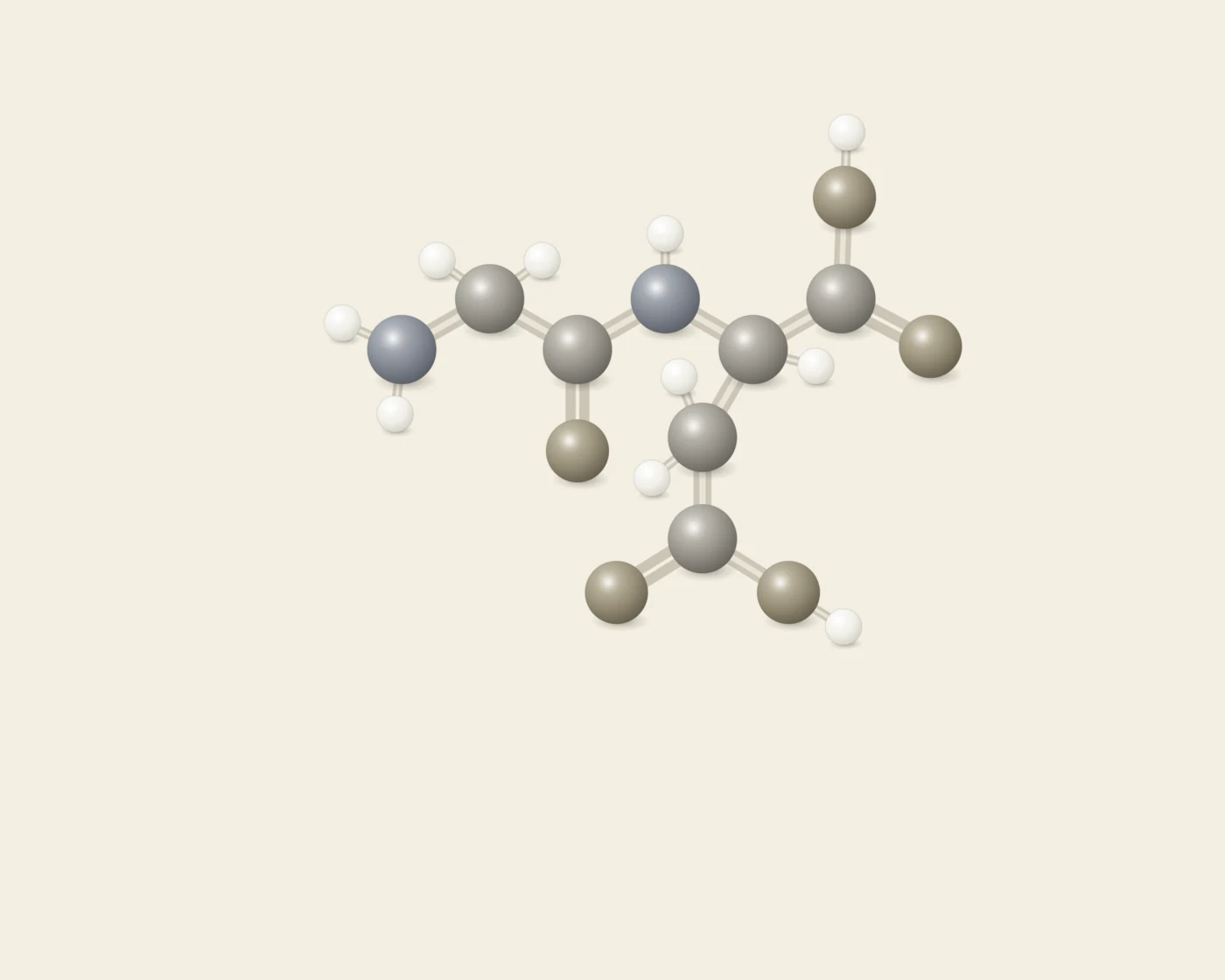
What Cardiogen is
Cardiogen is a synthetic tetrapeptide: four amino acids, alanine-glutamate-aspartate-arginine, sold under the sequence AEDR. It was designed within Vladimir Khavinson's bioregulator programme and pointed at one organ, the heart. The idea is that a short peptide modelled on cardiac tissue can carry regulatory information back to that tissue.
It matters to you, before the marketing does anything, that Cardiogen is a defined chemical rather than an organ extract. You know exactly which four residues are in the vial, which makes it clean to characterise in a dish.
Clean to characterise is a long way from well evidenced. The literature attached to AEDR runs to a handful of rat-tissue culture papers and some review articles, which is far less than a buyer is usually told.
Where the AEDR peptide sits in the Cytogen class
In Khavinson's scheme the short synthetic peptides of two to four amino acids are the Cytogens, built to mimic the longer Cytomax preparations that were originally pulled from animal tissue. Cardiogen is the cardiac-directed Cytogen, made from scratch to a single formula.
So Cardiogen is to a crude heart extract what Epitalon is to the pineal extract epithalamin: a defined molecule standing in for a messy one. The difference is that Epitalon inherited a real human evidence base. Cardiogen inherited almost none.
Cardiogen is not a registered drug anywhere
Cortexin, the brain-directed peptide from the same country and tradition, is a registered prescription medicine in Russia with a hospital history. Cardiogen has no such status, in Russia or anywhere else.
There is no MHRA, FDA or EMA authorisation, and no Russian marketing authorisation either. What you can buy is a research compound: a lyophilised powder for reconstitution and subcutaneous injection, or an oral capsule in the retail bioregulator lines. Neither format has been through a regulator.
02 / MechanismHow Cardiogen is proposed to work
The mechanism claimed for Cardiogen is the general bioregulator hypothesis, applied to the heart. It is a proposal about what AEDR should do to cardiac cells, and every piece of support for it comes from a test tube or a dish.
The AEDR peptide-into-the-nucleus idea
The hypothesis is that these very short peptides enter the cell, reach the nucleus, and bind specific sequences in DNA or the histone proteins that package it, nudging which genes are read. It casts the peptide as a tiny epigenetic signal rather than a drug that blocks a receptor.
For Cardiogen specifically there is one piece of direct biochemistry: the AEDR sequence was among short peptides shown to bind fluorescently labelled wheat histones in a test tube.4 That is a binding result in a plant-protein model, offered as support for the epigenetic story, not a demonstration of gene regulation in a heart cell.
Getting the tetrapeptide into the cell at all
A fair question about any four-amino-acid peptide is how it crosses into cells. A 2023 modelling paper docked 26 of these ultrashort peptides against the LAT1, LAT2 and PEPT1 transporters and argued the binding sites are large enough to carry them.5
That paper models feasibility for the peptide family in silico. Nobody has measured Cardiogen crossing into a human heart cell, or into a human anything.
The cardiovascular-ageing framing
The most recent mechanistic case is a 2022 Khavinson-group review that lists the AEDR tetrapeptide among peptides thought to regulate the signalling molecules behind inflammaging and the senescence-associated secretory phenotype in cardiovascular cells.3 It is a hypothesis-shaping review, and it names AEDR as a candidate, not a proven agent.
In a dish the pieces are suggestive: a peptide that binds histones, a model that says it could enter cells, a review listing it as a cardiovascular candidate. The marketing's leap is from that to "repairs your heart." Every step between is unproven, and the largest, culture to a living person, is untested.
What the Cardiogen evidence actually shows
The Cardiogen evidence stops at an unusual point. There is cultured rat heart tissue, then nothing: no whole animal, no person.
Cardiogen in rat myocardium culture
Zakutskii, Chalisova and colleagues applied Cardiogen and three sister peptides to organotypic explants of heart, lung, prostate and pancreas from young (3-week-old) and aged (18-month-old) rats. At 0.05 ng/ml the peptides stimulated the matching tissue culture relative to control explants in every group.2 This is the foundational cardiac result, an explant in a dish.
Chalisova and colleagues tested Cardiogen at 10-12 M on myocardial tissue culture from 3- and 24-month-old rats. They reported a strong stimulating effect on cell proliferation in both young and old tissue, alongside a fall in p53 protein expression, which they read as Cardiogen inhibiting apoptosis in the myocardium.1
Take both at face value and you have a coherent organotypic-culture story: Cardiogen nudged cultured heart tissue towards proliferation and away from cell death, in rat explants, at picomolar and sub-nanogram concentrations. What that is not is evidence that injecting it changes anything in a living heart.
The missing tier: whole-animal studies
No whole-animal study of Cardiogen has been published. The rat tissue in those papers was cultured outside the body, not treated inside a living animal.
Most peptides in this family at least have a rodent study measuring an outcome in the intact animal. For Cardiogen the chain stops at the explant, and we rate that missing tier the most damaging thing in the file.
Human studies on Cardiogen: there are none
No randomised trial, no open-label cohort and no case series of Cardiogen in people has been published in the indexed literature.
When a vendor implies clinical support for a cardiac peptide, what sits behind it is two rat-explant papers and a review article naming AEDR as a candidate.3 The human column is empty.
What remains unproven
No study has shown that Cardiogen improves heart function, survival or any clinical endpoint in an animal, let alone a person.
The mechanism is a hypothesis with a little in-vitro support, the efficacy is a cell-culture signal, and the human evidence does not exist. That does not make Cardiogen a fraud. It makes almost every health claim we can find attached to it an extrapolation across steps nobody has taken.
04 / Benefits by evidenceCardiogen benefits: the claims, and what the evidence supports
Buy Cardiogen for the cell-culture result and you are paying for something a laboratory has seen. Buy it for your heart and you are paying for the distance between the two. Only the smallest of the three claims below has a study attached.
Most supported, which is not the same as proven. The proliferation and anti-apoptotic signals in rat myocardium culture are real findings.1,2 They are also organotypic culture, from one lab network, and they say nothing yet about your heart.
Hypothesis only. The idea that Cardiogen counters inflammaging in vessels and heart comes from a review listing AEDR as a candidate,3 not from an experiment measuring it. Treat "protects your cardiovascular system" as a proposal.
Least supported, and the claim to walk away from. There is no human evidence that Cardiogen treats, prevents or improves any cardiac condition, and presenting it as a heart therapy runs past the data and the law.
The evidence hierarchy runs opposite to the marketing hierarchy: the boldest claim, treating heart disease, has no human evidence, while a cell-level effect on cultured myocardium is the only one with a study behind it. We rank Cardiogen below every peptide in the range that can show an outcome in a living animal.
05 / Dosage and protocolCardiogen dosage and protocol
The figures below are what sellers put on a label, and none of them is a dose you should take on our say-so. No dose-finding study for Cardiogen in humans exists.
Why the study concentrations are not doses
The only numbers in the real literature are dish concentrations: 0.05 ng/ml in one culture study and 10-12 M in the other.1,2 Those describe how much peptide bathed cells in a well, not how much you would inject or swallow.
Nobody has translated a well concentration into a systemic human dose. Any vendor presenting a Cardiogen dose as clinically derived has made the conversion up.
Where the vendor dosing protocol actually comes from
Sold as an injectable, Cardiogen is offered with short-course instructions that mirror the wider bioregulator range: a small daily amount over a run of days, repeated periodically. These come from vendor labels and community habit, not from any trial of this peptide.
The correct human dose of Cardiogen is unknown, because nobody has studied it. A day count and a milligram figure on a box are not the same as an answer.
Taking Cardiogen as capsules versus injection
The oral capsule is the easier product to sell, but a four-amino-acid peptide meets digestion in the gut, and how much survives intact to reach the heart is unestablished. The in-silico transport modelling is suggestive, not an answer.5
Neither the injectable nor the oral form has a human study behind it. You are choosing between two unvalidated formats.
06 / Safety and side effectsCardiogen safety and side effects
The safety statement is short: Cardiogen has not been studied for safety in humans at all. There is no trial reporting adverse events, because there is no human trial.
Why silence on side effects is not reassurance
A vendor claim of "no side effects" for Cardiogen rests on an empty file: no human trial has recorded any effect, good or bad. If you inject it, you are the first record anyone has.
Contamination and mislabelling: the risks that are actually likely
The likelier danger sits in the vial rather than in the biology. An unregulated injectable carries risks of bacterial and endotoxin contamination, mislabelling and underdosing, and reconstituting a powder yourself adds a sterility risk. What is in the vial is not guaranteed to be AEDR, or sterile, or accurately dosed.
Cardiogen is aimed at people worried about their hearts, which means some buyers already have cardiac disease and a prescription list. Adding an untested injectable to that picture is where an interaction, or a delay in proper care, stops being theoretical.
Who should not use Cardiogen
Anyone who is pregnant or breastfeeding, since it is untested there; anyone with active heart disease, who has real treatments to protect; and anyone dosing without a clinician who knows their history and their medication list.
Two rat-explant papers is the whole case for injecting this. Take that to a cardiologist who has your notes and your medication list before you take it anywhere else.
07 / SourcingWhere to buy Cardiogen safely in the UK
Because Cardiogen is a single defined sequence, you can at least verify what you were sent, which is more than the crude extracts allow. Verification depends on paperwork that most grey-market sellers we have looked at do not supply.
How to verify what you actually received
Insist on a certificate of analysis showing identity and purity by HPLC and mass spectrometry, with the sequence and mass matching Ala-Glu-Asp-Arg. Prefer suppliers who publish third-party testing, and for injectables ask about sterility and endotoxin testing.
What often arrives instead is a vial with a Cyrillic label, no certificate, and a powder you are trusted to accept on faith.
Telling Cardiogen from Chelohart and Ventfort
At the point of purchase Cardiogen is most often confused with Chelohart, the oral heart-tissue Cytomax extract, and with Ventfort, which is vascular rather than cardiac. Chelohart is a mixture pulled from cattle heart muscle; Cardiogen is the synthetic AEDR tetrapeptide, one defined sequence.
Unrelated products that simply share "cardio" branding add to the muddle. If a listing borrows the clinical language of Cortexin or a registered drug, remember that none of that history attaches to this peptide.
The cheapest way to sell a Cardiogen label is to put something else under it, so a price well below the market tells you what the seller saved money on.
08 / ComparisonCardiogen versus Cortexin and the other bioregulators
Cardiogen is often shelved beside Cortexin as another Russian organ peptide, and the shelving flatters it. Cortexin is a registered prescription drug with a hospital track record; Cardiogen is a research compound whose evidence stops at cultured rat tissue. We would not let a shelf position stand in for a data set.
Against Epitalon, the class flagship, the gap is the human data: Epitalon has a mouse lifespan study and a human melatonin signal, while Cardiogen has neither an animal outcome nor a person. You can place all of them side by side, by format and evidence strength, on our bioregulator peptide types guide.
Frequently Asked Questions
What is Cardiogen peptide and what is it made of?
Cardiogen is a synthetic tetrapeptide, the sequence Ala-Glu-Asp-Arg (AEDR), from Khavinson's Cytogen class of short cardiac-directed peptides. It is built in a lab to a defined formula rather than extracted from tissue, and it is aimed at the myocardium.
What tissue is Cardiogen derived from?
None. Cardiogen is synthesised to the sequence Ala-Glu-Asp-Arg rather than extracted from any organ. The tissue link is indirect: the Cytogens were built to mimic the older organ extracts, and the cardiac extract in that range is Chelohart, so the organ Cardiogen is modelled on is the myocardium.
Is there human clinical evidence for Cardiogen?
No. No randomised trial, cohort or case series of Cardiogen in people has been published in the indexed literature. The evidence is organotypic rat-tissue culture and Khavinson-group review articles, so any human health claim is an extrapolation.
What does Cardiogen peptide do?
In cultured rat heart tissue, and nowhere else that anyone has measured, Cardiogen stimulated cell proliferation in young and old explants and lowered p53 expression, read as reduced apoptosis. Those effects were seen at 0.05 ng/ml and 10 to the minus 12 molar in a dish, not in a living animal or person.
Is Cardiogen legal to buy in the UK?
Not as a medicine. Cardiogen holds no MHRA authorisation, so it cannot be sold or prescribed as one here, only as a research compound, which leaves a personal purchase outside any regulatory protection. Cortexin is a registered drug in Russia; Cardiogen is authorised nowhere, and the FDA and EMA have never assessed it.
What is the correct Cardiogen dosage?
There is no validated human dose, because no human study exists. The concentrations in the research were dish concentrations for cell culture, not injectable doses. Vendor protocols mirror other bioregulators as short courses, but those are conventions, not clinically established figures.
How long should a Cardiogen course last?
No study has established a course length, because no human study of Cardiogen exists. Vendors sell it as a short course, a small daily amount over a run of days, repeated periodically. That pattern is borrowed from the wider bioregulator range, so any day count you see comes from a label, not a trial.
Should Cardiogen be injected or taken as capsules?
Neither route has a human study behind it. The oral capsule faces gut digestion of a four-amino-acid peptide, and how much survives is unestablished. A 2023 model suggested transporters could carry such peptides, but that is a computer prediction, not a measured result.
Does Cardiogen have side effects?
Nobody knows, because it has never been tested in people. "No side effects" claims reflect the absence of studies, not proven safety. For an unregulated injectable, contamination, mislabelling and sterility are the practical risks, on top of the untested biology.
How do you spot fake Cardiogen?
Ask for a certificate of analysis with HPLC and mass-spec identity matching Ala-Glu-Asp-Arg, prefer third-party-tested suppliers, and be wary of prices far below the market. For injectables, ask about sterility and endotoxin testing before you buy.
- Chalisova NI, Lesniak VV, Balykina NA, et al. [The effect of the amino acids and cardiogen on the development of myocard tissue culture from young and old rats]. Adv Gerontol. 2009;22(3):409–413. PMID: 20210190.
- Zakutskiĭ AN, Chalisova NI, Ryzhak GA, et al. [The tissue-specific effect of synthetic peptides-biologic regulators in organotypic tissues culture in young and old rats]. Adv Gerontol. 2006;19:93–96. PMID: 17152728.
- Khavinson V, Linkova N, Dyatlova A, Kantemirova R, Kozlov K. Senescence-associated secretory phenotype of cardiovascular system cells and inflammaging: perspectives of peptide regulation. Cells. 2022;12(1):106. PMID: 36611900.
- Fedoreyeva LI, Smirnova TA, Kolomijtseva GY, Khavinson VKh, Vanyushin BF. Interaction of short peptides with FITC-labeled wheat histones and their complexes with deoxyribooligonucleotides. Biochemistry (Mosc). 2013;78(2):166–175. PMID: 23581987.
- Khavinson VK, Linkova NS, Rudskoy AI, Petukhov MG. Feasibility of transport of 26 biologically active ultrashort peptides via LAT and PEPT family transporters. Biomolecules. 2023;13(3):552. PMID: 36979488.